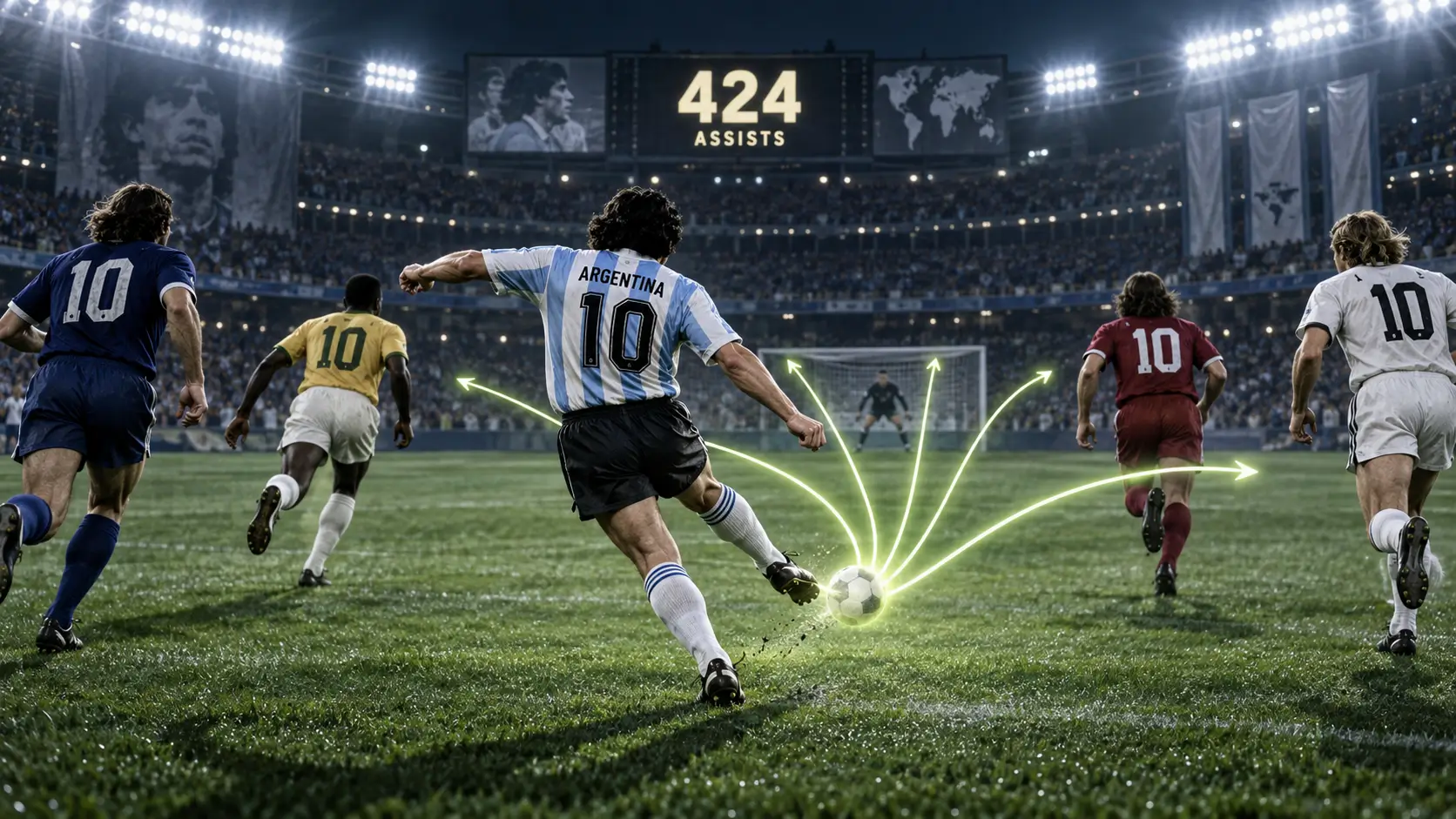
Lionel Messi leads the career-assist ranking published by the International Federation of Football History and Statistics, which recognized his 400-assist milestone in November 2025. Pele, Ferenc Puskas and Johan Cruyff follow in that dated historical study. Their exact totals should be attributed to the research rather than presented as universally agreed official records.
This guide examines ten football players with outstanding assist records and explains what their numbers can establish. The opening table uses one identifiable historical source. The later player profiles discuss other major creators without pretending that estimates from different providers form a precise current world leaderboard.
Reviewed: 21 October 2026. The IFFHS career table is a historical snapshot published on 9 November 2025. It is not a live October 2026 ranking. Active-player lifetime totals have not been independently refreshed for this revision.
Who Has the Most Assists in Football History?
Messi is first in the IFFHS study. That is the strongest source-specific answer used here. A broader claim covering every possible assist definition would require complete, comparable historical records that football does not have.
Assist totals are more difficult to compare than goals because a provider must decide which preceding action deserves credit. A direct pass, a deflection and a shot followed by a rebound can be classified differently. Historical researchers also have to work with incomplete reports and footage.
For a closer modern comparison, our Messi vs Ronaldo assists analysis explains why the counting method matters alongside the headline total.
The Dated IFFHS Career Assist Ranking
| Player | Assists in the study | Source scope |
| Lionel Messi | 400 | IFFHS snapshot of 9 November 2025 |
| Pele | 369 | Historical reconstruction in the same study |
| Ferenc Puskas | 359 | Historical reconstruction in the same study |
| Johan Cruyff | 346 | Historical reconstruction in the same study |
Source name: IFFHS, Lionel Messi The First Ever. The organization describes its table as a reconstruction of assists in top-level official matches. These figures share that publication’s scope; they should not be combined with a different provider’s broader estimates to create a new numerical order.
The remaining six profiles below are selected examples of prolific creators. They are not certified positions five to ten in a current worldwide ranking. A precise extended table would require comparable career totals with matching definitions and dates.
Ten Notable Career Assist Providers
Lionel Messi
Messi’s creative game extends beyond the final pass. He can receive between midfield and attack, carry the ball toward defenders and release a teammate once space opens. Through balls, cutbacks, short combinations and set pieces all form part of his playmaking.
His combinations with Neymar and Luis Suarez at Barcelona illustrate how creation and finishing can reinforce each other. A defender stepping toward Messi risks opening a passing lane; allowing him space creates a shooting opportunity. That makes him difficult to assess through assists alone.
The IFFHS milestone is a dated achievement, not his present lifetime count. The supplied draft’s approximately 424 assists was a September 2026 working figure and has not been independently verified as an October total. This revision therefore does not label it current.
For the wider partnership and individual comparison, read Messi vs Neymar.
Pele
Pele’s creativity deserves attention alongside his goals. He could combine quickly, draw defenders and release runners rather than always taking the final shot. His pass for Carlos Alberto’s goal in the 1970 World Cup final remains a clear example of timing and awareness.
His historical assist total depends on reconstruction across a period without modern live-data coverage. That does not diminish the quality of his passing; it limits how precisely we can compare every recorded final touch with one from a recent match.
IFFHS places Pele second in the historical table reproduced above. This article follows that source’s order rather than promoting a larger number found in a different compilation. Our Messi vs Pele comparison considers their wider careers and the difficulties of comparing eras.
Ferenc Puskas
Puskas combined finishing with the ability to create for teammates. His left-footed passing and combinations made him more than a player waiting near goal. At Real Madrid, he and Alfredo Di Stefano could share scoring and creative responsibilities.
His career also illustrates the main problem with historical assist lists. Match reports and footage can help reconstruct the last pass, but they do not automatically establish identical coverage or rules across every season. A higher estimate is not necessarily a more complete or more accurate one.
This article uses the IFFHS figure in its dated table. It does not turn the smallest and largest numbers found elsewhere into a validated statistical range.
Johan Cruyff
Cruyff could influence an attack before receiving the ball. His movement changed defenders’ positions, while his passing and dribbling helped teammates exploit the space created. He could move centrally, drop deeper or appear on the wing rather than remain in one fixed attacking lane.
That influence helps explain his reputation as a creator, but tactical importance and recorded assists measure different things. A move can depend on Cruyff’s positioning even when someone else supplies the last pass.
IFFHS includes him fourth in its historical study. The reconstructed figure belongs to that source and period of research, rather than a universal database covering every assist definition.
Thomas Muller
Muller shows why a creator does not need to look like a conventional number ten. His movement can take him into an unprotected area, leaving a relatively simple pass to set up a teammate. The apparent simplicity of the assist can conceal the intelligence of the run.
His long Bayern Munich career and international football made him a frequent participant in attacking combinations. Short final passes, cutbacks and deliveries from wide areas were all part of his game.
The supplied draft included widely differing compiled lifetime totals for Muller without a traceable, matching provider basis. This revision removes that numerical range rather than assigning him an exact world position from incompatible counts.
Dusan Tadic
Tadic is another example of a player whose creative contribution can be overlooked in a discussion dominated by goalscorers. He has operated both wide and centrally, using crossing, combinations and set pieces to create chances.
His Ajax period brought particular attention to his ability to organize attacks and combine around the penalty area. Longevity across different competitions also matters when evaluating an accumulated record.
A career total needs consistent coverage across those competitions. This profile recognizes his creative output without claiming that an unverified, changing lifetime figure establishes sixth place in the world.
Alex de Souza
Alex was a creative attacking midfielder who could supply the final pass and score himself. His passing, set pieces and work around the penalty area made him an important attacking influence at clubs including Palmeiras, Cruzeiro and Fenerbahce.
He also demonstrates why incomplete coverage should not be confused with a small contribution. A career spread across different statistical systems can be difficult to combine even when individual seasons are well documented.
IFFHS specifically identifies Alex as another player above 300 assists while noting that his precise total was unsettled. That finding supports his inclusion here without requiring an invented exact placement among the six additional profiles.
Luis Suarez
Suarez’s ability to create is an important part of his attacking game. He can combine around the box, move away from central defenders and release runners with short passes or cutbacks. His work alongside Messi and Neymar made that balance especially visible.
A striker’s assist total should also be read in the context of his scoring threat. Defenders responding to a possible shot can open a passing opportunity. The reverse is also true: a convincing passing option can help create room to finish.
His broader profile belongs in a discussion of the best strikers of all time, where scoring, movement and creative influence can all receive attention. An exact updated lifetime assist total is not certified here.
Kevin De Bruyne
De Bruyne’s passing can create a chance before the defence has time to reset. Early crosses, through balls and passes across the penalty area are central to his game. His speed of decision is often as important as the difficulty of the pass itself.
One clearly documented competition milestone is his arrival at 100 Premier League assists in 237 appearances, a record recognized by the league and Guinness World Records. It is an example of an assist achievement with an explicit competition and appearance count.
That milestone should not be confused with a lifetime club-and-country total. His career also includes other leagues, cup matches and internationals, which require their own coverage and matching rules.
Luis Figo
Figo was a wide creator who could beat a defender and provide the final ball. Crossing, dribbling and combinations helped him create from the flank, while set pieces offered another route to goal involvement.
His career spans different clubs and stages of football’s statistical coverage. A single compiled assist count needs a named provider and a stated scope before it can establish a precise position against other players.
This profile therefore retains his place among the selected creators without presenting the draft’s approximate lifetime count as a verified world-record figure.
Competition Assist Records
| Competition record | Player | Published figure |
| Premier League career assists | Ryan Giggs | 162 |
| UEFA Champions League career assists | Cristiano Ronaldo | 42 |
| Fastest to 100 Premier League assists | Kevin De Bruyne | 237 appearances |
Source names: Premier League official statistics, UEFA official assist rankings and Guinness World Records. These records each have a defined competition. They do not establish the same player’s position in a worldwide career table.
Ronaldo’s Champions League lead is particularly useful context because a competition-specific comparison can differ from a career-wide one. Our Messi vs Ronaldo stats comparison separates those questions.
What Counts as an Assist?
A goal assist generally concerns the qualifying final action before a teammate scores, but the precise rules belong to the provider. Stats Perform’s Opta Event Definitions distinguishes goal assists from broader fantasy-assist events.
Winning a penalty or supplying a shot that is saved before another player scores should not automatically be treated as the same event as a direct final pass. Defensive touches and rebounds require the provider’s specific rules. Comparing a broad fantasy count for one player with a stricter goal-assist count for another produces a misleading result.
For this article, a numerical record is presented with its source and scope. We do not claim to have independently reconstructed a complete match ledger for all ten players.
Why Historical Assist Records Need Caution?
Many older matches lack complete footage or detailed event logs. Researchers may have to identify a final pass from a newspaper account, and reports can differ in what they record. Some competitions are also documented more thoroughly than others.
These limitations make a historical reconstruction useful but distinct from live event data. Mixing several published estimates does not produce a statistical confidence interval. Nor should the gap between two websites be treated automatically as an established range of possible values.
The appropriate response is to name the source, state the date and avoid claiming more certainty than the evidence supports. This is why the dated historical table is separate from the six additional creator profiles.
Most Assists and Best Playmaker Are Different Questions
Career assists measure accumulated credited events. They do not capture every valuable pass, run or decision, and they also depend on a teammate completing the chance.
A playmaker assessment may consider passing difficulty, chance quality, tactical influence, consistency and performance under pressure. A player who supplies the pass before the assist can be central to a move without receiving the assist itself.
For that wider positional discussion, explore the best attacking midfielders of all time. For a different measure of attacking output, see the football players with the most career goals.
Frequently Asked Questions
Who Has the Most Assists in Football History?
Messi leads the IFFHS historical career-assist study used here. The table is explicitly dated; it should not be described as a live October 2026 count.
How Many Career Assists Does Messi Have?
His exact current total needs a provider, definition and match cutoff. The verified milestone used here is the IFFHS 400-assist recognition in November 2025. This revision does not independently certify the September draft’s approximate 424 as a current figure.
Is Pele or Puskas Second for Assists?
IFFHS places Pele second and Puskas third in its November 2025 study. Other reconstructions can differ, so that order must be attributed to its source.
Are These Ten Players an Official World Top Ten?
No. The first four follow the cited historical study; the remaining six are selected major creators whose precise current order is not independently established here. There is no single official worldwide table with uniform coverage throughout football history.
Who Has the Most Premier League Assists?
Ryan Giggs holds the league’s published career record with 162. This is a Premier League record, not a combined total across all competitions and international matches.
Who Has the Most Champions League Assists?
UEFA lists Cristiano Ronaldo first with 42 assists. Those figures use UEFA’s competition record and should remain separate from an unrelated career database.
Do Corners Count as Assists?
A corner can receive assist credit when it supplies the qualifying final action before a teammate scores. Additional touches and other unusual situations depend on the statistical provider’s rules.
Why Do Websites Show Different Totals?
Definitions, match coverage, cutoff dates and historical reconstruction can differ. Compare those conditions before treating two numbers as contradictory.
Sources
IFFHS historical career assist study published on 9 November 2025.
Stats Perform Opta Event Definitions.
Premier League official player statistics and historical records.
UEFA official Champions League assist rankings.
Guinness World Records for the fastest 100 Premier League assists.
Conclusion
Messi leads the dated IFFHS career-assist study, while Pele, Puskas and Cruyff form its historical top four. Muller, Tadic, Alex, Suarez, De Bruyne and Figo are important additional creators, but the available evidence here does not justify assigning them exact current world positions.
The most useful assist comparison identifies what was counted and when. A clearly scoped historical record or competition milestone offers more reliable information than a current-looking table assembled from incompatible estimates.