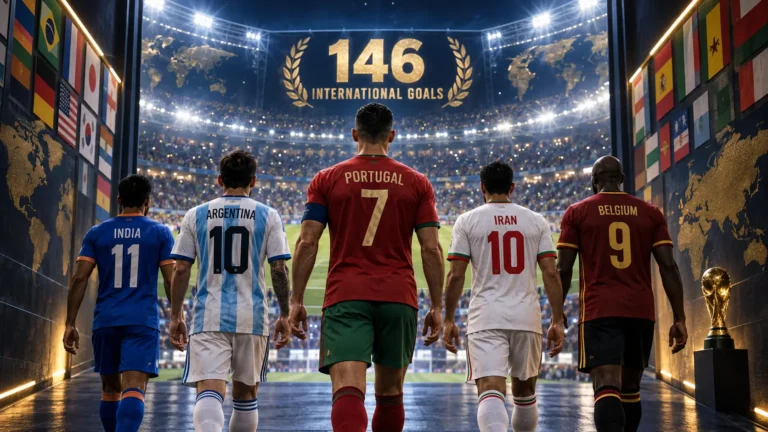
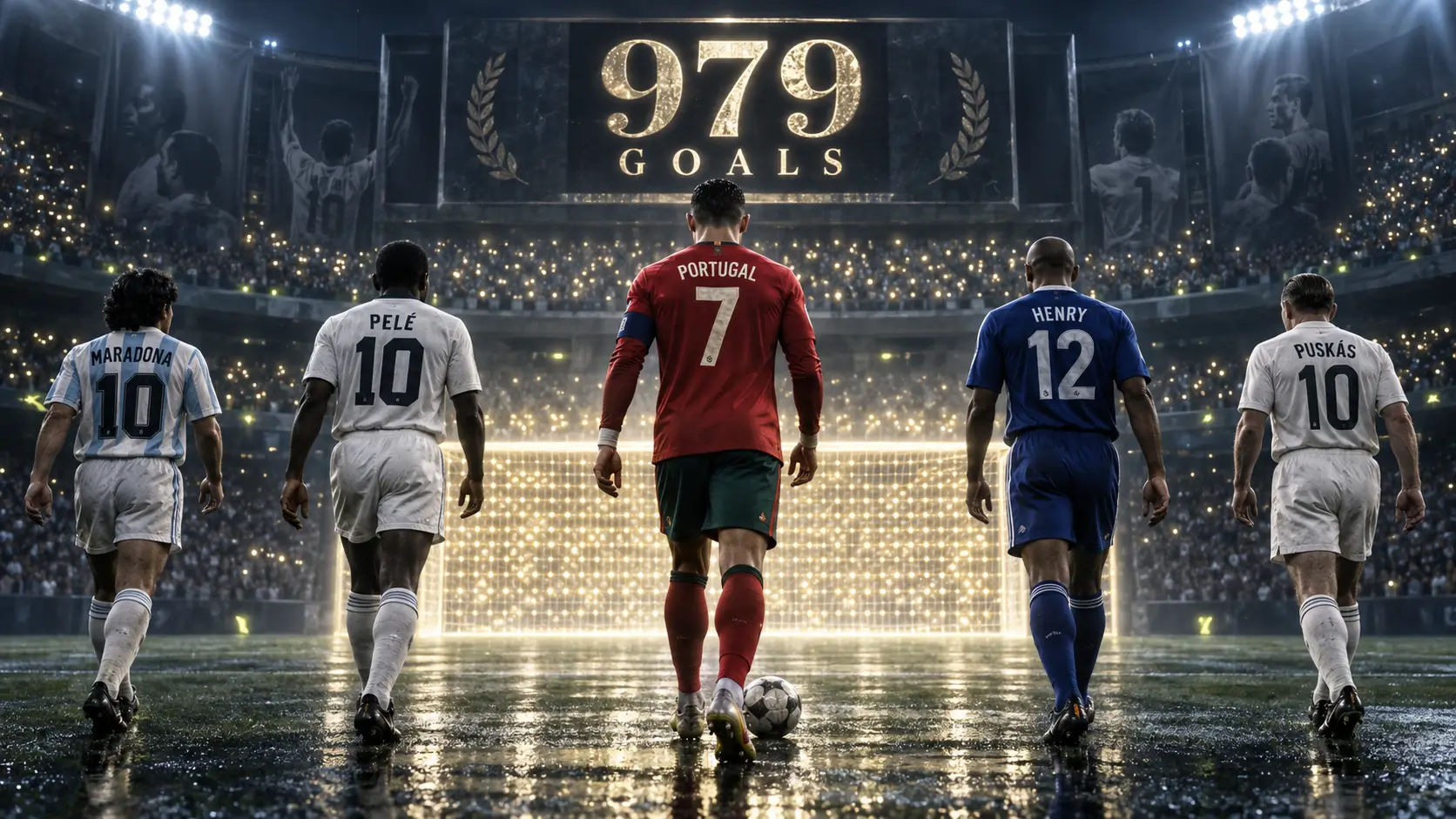
Do you know, all about 10 football players with most career goals in history? Cristiano Ronaldo leads this ranking of football players with most career goals with 981 top-level goals. Lionel Messi follows with 934, while Pelé takes third with 762 under the historical classification used here. Ronaldo needs 19 more goals to reach 1,000 in this count.
This list covers men’s football and follows the IFFHS-based top-level ranking used in our earlier edition. Active-player figures use the checked 2026 snapshot below. Historical totals depend on which competitions and representative matches a database includes, so we explain those limits before comparing players from different eras.
Reviewed 2026 | Active totals can change after another match
Key Takeaways
Ronaldo leads Messi by 47 goals in the checked snapshot.
Ronaldo, Messi and Robert Lewandowski are the active players in this Top 10.
Lewandowski has 707 goals under the top-level count used here.
Historical figures follow the IFFHS-based classification. They are not complete totals from every senior competition.
Penalties during a match count. Penalty shootout conversions do not count as individual career goals.
Top 10 Football Players With Most Career Goals
The order is based on goal totals, without points for trophies, fame or playing style. The period column describes the span counted in the source framework; it may start later than a player’s first senior match. Lower-division and reserve goals can fall outside this count.
| Rank | Player | Country | Top-level Goals | Period Counted | Status |
| 1 | Cristiano Ronaldo | Portugal | 981 | 2002–present | Active |
| 2 | Lionel Messi | Argentina | 934 | 2004–present | Active |
| 3 | Pelé | Brazil | 762 | 1957–1977 | Career ended |
| 4 | Romário | Brazil | 756 | 1985–2007 | Career ended |
| 5 | Ferenc Puskás | Hungary / Spain | 725 | 1943–1966 | Career ended |
| 6 | Josef Bican | Austria / Czechoslovakia | 722 | 1931–1955 | Career ended |
| 7 | Robert Lewandowski | Poland | 707 | 2008–present | Active |
| 8 | Jimmy Jones | Northern Ireland | 639 | 1947–1964 | Career ended |
| 9 | Gerd Müller | West Germany | 634 | 1964–1981 | Career ended |
| 10 | Joe Bambrick | Ireland (IFA) | 626 | 1926–1943 | Career ended |
Historical totals are source-specific. For example, Pelé’s 762 is the IFFHS-based figure retained here, rather than a claim that every other published competitive total is wrong. This table is not a FIFA-certified all-time list.
What Counts in This Career Goals Ranking?
For current players, career scoring combines competitive senior first-team club goals with recognized senior national-team goals. Club leagues, domestic cups, continental tournaments and recognized international club competitions can contribute. Senior national-team friendlies also count in standard international records.
The top-level filter is narrower than every official senior match. It does not automatically include goals from lower divisions, reserve teams or regional competitions. Historical competition structures also need separate classification. We retain the established historical figures rather than claiming to have recalculated every old match.
Ordinary club friendlies, youth games, training matches and testimonials are excluded from the main count. A penalty scored during normal time or extra time counts as a goal. A conversion in a penalty shootout does not.
Why Official and Top Level Are Different?
An official lower-division match can still fall outside a top-level ranking. Lewandowski’s early scoring in Poland is one example of why a complete senior-career total may exceed the figure in this table. His 2008 start in the period column describes this count, rather than his first year playing senior football.
For historical players, country and other representative goals in a statistical table may also differ from modern senior national-team totals. Pelé’s 762 should not be rebuilt by adding a club total from one source to a Brazil total from another. Each total needs the match categories used by its source.
Why Career Goal Totals Differ Between Sources
There are three separate questions: which matches were played, how many goals a player scored, and which matches qualify for a particular record. Old newspapers and club archives help answer the first two. Statistical rules decide the third.
RSSSF publishes separate lists for official matches across all levels, official top-level matches and all matches including friendlies. Even its top-level list differs from the IFFHS-based figures. The difference is therefore wider than simply official goals versus friendly goals.
A broader count can include regional or reserve leagues, selected representative teams and other recognized tournaments. That changes several historical positions. We keep those counts separate from the main ranking and avoid treating one database’s definition as the only valid record.
1 Cristiano Ronaldo 981 Goals
Country: Portugal
Period counted: 2002–present
Top-level goals: 981
Status: Active
Cristiano Ronaldo leads the top-level career-goals ranking used on this page.
His career has taken him through Sporting CP, Manchester United, Real Madrid, Juventus, Al Nassr, and Portugal.
The largest part of his club total came at Real Madrid. LaLiga lists 450 goals in 438 Real Madrid matches. Madrid’s own archive lists 451, so the club’s figure should not be substituted into the career count without checking goal attribution. That made him Real Madrid’s all-time leading scorer. He also became the UEFA Champions League’s record scorer.
His international total is just as historic. Ronaldo’s Portugal goals form part of the career total. His international record is a separate subset of the same goals. The remarkable part is longevity. Ronaldo began his senior career in 2002. More than two decades later, he continues scoring in official competition.
The checked 2026 snapshot places him on 981 goals. His club scoring can still increase the total.
2 Lionel Messi 934 Goals
Country: Argentina
Period counted: 2004–present
Top-level goals: 934
Status: Active at club level
Lionel Messi ranks second.
His career scoring has come for Barcelona, Paris Saint-Germain, Inter Miami, and Argentina.
The foundation of his total was Barcelona. Messi scored 672 official goals for Barcelona. That remains the highest widely recognized official goal total for one player at a single club. His scoring peak combined huge volume with exceptional efficiency.
Messi scored from open play, free kicks, penalties, long-range shots, dribbles into the box, and close combinations.
He was never simply a penalty-box striker. That makes the size of his total even more unusual. Messi’s international scoring also continued late into his career. Messi ended his Argentina career in 2026 with 126 goals, while continuing to play club football for Inter Miami. His checked career total is 934 goals, including his Barcelona, Paris Saint-Germain, Inter Miami and Argentina scoring.
Ronaldo’s lead in this snapshot is 47 goals. Messi remains active, so his final total is not yet fixed.
3 Pelé 762 Goals
Country: Brazil
Period counted: 1957–1977
Top-level goals: 762
Pelé is where the methodology debate becomes much more important.
Published Pelé totals include more than 1,000 goals, 1,279 goals, 1,281 goals, and 762 goals.
How can one player have so many different totals? The answer is match classification. Pelé played during an era when Santos regularly travelled for lucrative exhibition matches. Many of those games attracted huge crowds and strong opponents. They were important events. They were not always official competitive fixtures under modern statistical definitions.
The IFFHS-based historical figure retained in this ranking is 762. Other competitive counts differ because their match classifications differ. His broader career totals can exceed 1,000 when club friendlies and other matches are included. Pelé’s official total remains extraordinary. He combined his Santos scoring with major Brazil success, including three World Cup titles.
4 Romário 756 Goals
Country: Brazil
Period counted: 1985–2007
Top-level goals: 756
Romário is another player associated with the famous 1,000-goal milestone. He celebrated reaching what was presented as his 1,000th career goal in 2007. That total used a broader counting method. It included goals outside the strict top-level competitive definition used in our main table. The IFFHS-based total used in this table is 756 goals.
That still makes him one of the greatest finishers in football history.
Romário scored for clubs across Brazil, Netherlands, Spain, Qatar, and United States.
His peak club periods included PSV and Barcelona. He was also central to Brazil’s 1994 World Cup victory. Romário’s scoring style was different from Ronaldo’s. He did much of his best work inside and around the penalty area.
His game relied on movement, quick finishing, anticipation, balance, and deceptive touches.
5 Ferenc Puskás 725 Goals
Countries: Hungary / Spain
Period counted: 1943–1966
Top-level goals: 725
Ferenc Puskás ranks fifth with 725 goals. He was one of football’s great left-footed scorers.
His career was divided mainly between Budapest Honvéd, Real Madrid, Hungary, and Spain internationally later in his career.
Puskás was already a legendary scorer before arriving in Madrid. He then joined one of European football’s greatest attacking teams. At Real Madrid, he scored 242 competitive goals in 262 matches. His combination with Alfredo Di Stéfano helped Madrid dominate European competition. One of his most famous performances came in the 1960 European Cup final.
Puskás scored four goals as Real Madrid defeated Eintracht Frankfurt 7-3. His international record for Hungary was also extraordinary. Like several older players, Puskás can receive larger career totals under broader systems that count additional competitions. Our table retains the IFFHS-based figure of 725. It describes the chosen record category rather than every match Puskás played.
6 Josef Bican 722 Goals
Countries: Austria / Czechoslovakia
Period counted: 1931–1955
Top-level goals: 722
Josef Bican is the most difficult player on this list to summarize with one number.
Published Bican totals include 722, 805, more than 900, and around 950.
Those figures use different definitions.
Bican played through an unusual period of European football that included changing national borders, wartime leagues, different competition structures, regional football, and incomplete historical records.
Some broader historical research credits him with far more goals than our table does. FIFA has previously referenced an estimated total of 805. Other research databases go higher. The 722 figure belongs to the IFFHS-based top-level ranking retained here. His goalscoring rate remains one of the most remarkable in football history.
7 Robert Lewandowski 707 Goals
Country: Poland
Period counted: 2008–present
Top-level goals: 707
Status: Active
Robert Lewandowski is the third active player in our Top 10. He has now passed 700 top-level goals.
His senior club scoring includes Polish club football, Borussia Dortmund, Bayern Munich, Barcelona, and Chicago Fire.
His greatest scoring years came in Germany. At Bayern, Lewandowski became one of the most reliable No. 9s of the modern era.
His game combines penalty-box movement, first-time finishing, heading, penalties, link play, and two-footed shooting.
His Bundesliga campaign ending in 2021 was particularly historic. Lewandowski scored 41 league goals, breaking Gerd Müller’s long-standing single-season Bundesliga record. Internationally, he became Poland’s record scorer. Unlike Ronaldo and Messi, Lewandowski entered football’s truly elite scoring level slightly later. His sustained production through his thirties still pushed him beyond 700.
Because he remains active, this total can continue rising. From 707, he needs 16 goals to pass Bican’s 722 and 19 to pass Puskás’s 725 in this table.
8 Jimmy Jones 639 Goals
Country: Northern Ireland
Period counted: 1947–1964
Top-level goals: 639
Jimmy Jones is less globally famous than most names above him. His scoring numbers still demand inclusion. Jones spent the defining part of his career with Glenavon in Northern Irish football. He scored at an extraordinary rate. His career was also marked by a serious injury early on. Jones recovered and continued scoring for many years.
Under the top-level methodology used in our table, he finishes on 639 goals. Broader historical databases can credit him with substantially more because they include a wider range of competitions.
9 Gerd Müller 634 Goals
Country: West Germany
Period counted: 1964–1981
Top-level goals: 634
Gerd Müller ranks ninth. His nickname, Der Bomber, described his game perfectly. Müller lived for goals. He rarely needed several touches.
His greatest strengths were penalty-box movement, reactions, balance, finishing, anticipation, and unusual shooting angles.
His Bayern Munich career helped the club become a leading European team. Müller won major domestic titles and three consecutive European Cups. His international achievements were equally strong. He scored the winning goal in the 1974 World Cup final as West Germany defeated the Netherlands. Broader statistical systems give him totals above the 634 used here.
10 Joe Bambrick 626 Goals
Country: Ireland (IFA)
Period counted: 1926–1943
Top-level goals: 626
Joe Bambrick completes our Top 10 with 626 goals. Most of his scoring came in Irish football. He became especially associated with Linfield. He was a strong central forward and a prolific penalty-box finisher. One of his most famous international achievements came when he scored six times for Ireland against Wales in 1930.
Our table retains the historical figure of 626 under the selected top-level classification.
Ronaldo vs Messi Career Goal Totals
| Player | Career Goals | Goals to Reach 1000 |
| Cristiano Ronaldo | 981 | 19 |
| Lionel Messi | 934 | 66 |
| Difference | 47 | — |
Ronaldo has the larger total in this snapshot. Messi’s total can still rise through club football after his Argentina retirement. The final gap depends on future appearances and goals, so neither a retirement date nor a catch-up result can be stated as certain.
Ronaldo’s 1,000-goal target requires another 19 goals under this count. Reaching that total would be a milestone in this top-level category. Historical claims above 1,000 can use broader match categories and should be labelled separately.
Historical Counts and the 1000 Goal Claims
| Player | Main Table | Alternative Count or Claim | Reason for Difference |
| Pelé | 762 | 1,279 in Guinness World Records | Broader career record including additional matches |
| Romário | 756 | Celebrated 1,000 in 2007 | Personal count included youth games and friendlies |
| Josef Bican | 722 | 950+ in RSSSF’s broader official list | More competition levels and representative matches |
| Erwin Helmchen | Outside this Top 10 | 989+ in RSSSF’s broader official list | Different competition coverage |
These alternative figures are not added to the main ranking. A plus sign means the published historical figure is a documented minimum within that source’s method. Guinness, RSSSF and the IFFHS-based ranking answer different statistical questions.
Helmchen’s absence does not mean his goals did not happen. His position depends on the competitions included. The same applies to Ronnie Rooke, Ferenc Deák and Abe Lenstra, who appear higher in some broader historical lists.
Career Goals and Other Scoring Records
Career goals cover a wider set of matches than a single competition. World Cup goals form part of international scoring, while Champions League goals form part of club scoring. Adding those subsets again would count the same goals twice.
For national-team scoring alone, see our football players with most international goals.
For the European club competition record, see our football players with most Champions League goals.
A player’s position on these narrower lists can differ from his career ranking. Winning more trophies or having a better goal ratio does not increase the raw number of career goals.
Could a Younger Player Challenge the Record
Erling Haaland is a relevant long-term candidate because of his scoring rate. Any future challenge depends on years of regular appearances, fitness and continued production for club and country. A few high-scoring campaigns cannot settle a record built over more than two decades.
Goal ratio supplies useful context but answers a separate question. Total goals measure accumulated scoring. Goals per match measure frequency, and that ratio is meaningful only when the goal and appearance totals use the same match categories.
Frequently Asked Questions
Who has the most career goals in football history?
Cristiano Ronaldo leads this men’s top-level ranking with 981 goals in the checked 2026 snapshot. Broader historical lists use different match categories.
Why does Lewandowski have different career totals?
His 707 here uses the top-level count. A complete senior-career total can include early lower-division goals in Poland that this framework excludes.
Did Pelé score more than 1000 goals
Yes, under broader career counts. Guinness World Records lists 1,279. The IFFHS-based figure in our main table is 762, so the two numbers should not be compared without their counting rules.
Why is Josef Bican listed with 722 goals?
That is the historical figure in the IFFHS-based ranking used here. RSSSF includes additional competitions and representative matches in its broader official list, producing 950+.
Do penalties and friendly goals count?
Penalties during normal time or extra time count; shootout conversions do not. Recognized senior international friendlies count in standard national-team records. Ordinary club friendlies are excluded from our main count.
Sources and Fact Checking
The historical order and figures follow the published IFFHS-based top-level classification. RSSSF’s Prolific Scorers Data provides the separate historical lists used to explain wider counts. Guinness World Records supports the Pelé figure of 1,279.
For active players, we compared the career totals with Messi vs Ronaldo App, El Gráfico and recent match reporting. The checked totals are 981 for Ronaldo, 934 for Messi and 707 for Lewandowski. Reuters and Associated Press reporting supports Messi’s international retirement and final Argentina total.
Official Barcelona, Real Madrid and LaLiga records support the club figures in the player profiles. Their different Ronaldo totals are stated locally rather than silently combined. Bundesliga records support Lewandowski’s 41-goal campaign. Chicago Fire confirms his 2026 move, and FIFA’s historical profile supports the alternative Bican estimate.
This is a fixed editorial snapshot, rather than an automatically updating counter. New goals require a fresh check. Historical revisions also need a review of match classifications, rather than a silent switch to the largest available total.
Conclusion
In short, Cristiano Ronaldo leads the football players with most career goals in this top-level ranking with 981, followed by Lionel Messi on 934. Pelé, Romário, Puskás, Bican, Lewandowski, Jones, Müller and Bambrick complete the Top 10. Ronaldo needs 19 goals to reach 1,000 in this count, while the historical figures remain tied to the stated source framework. Keeping those rules clear makes comparisons more useful than presenting every published total as the same record.