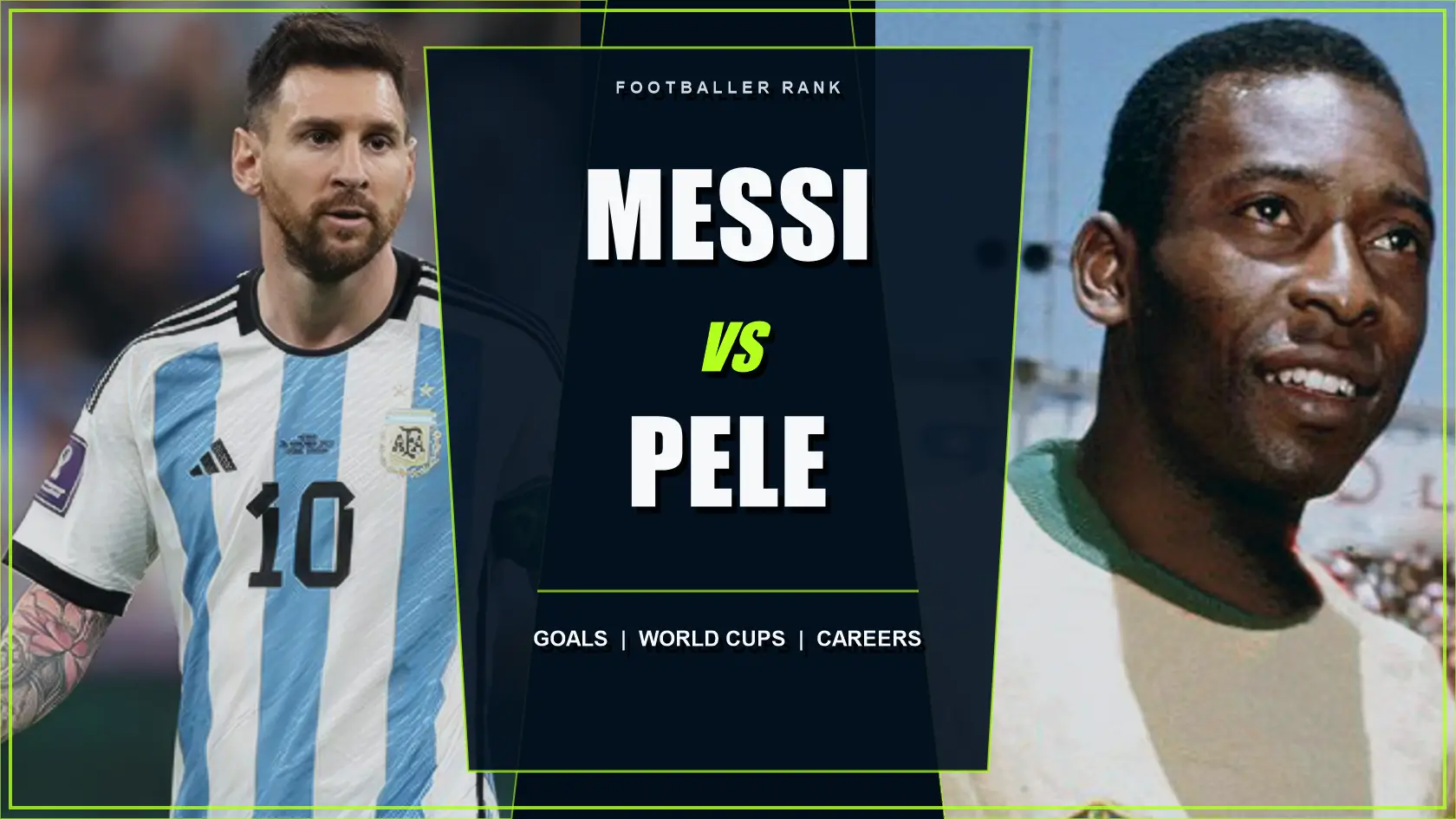
The Messi vs Pelé debate compares two football legends separated by more than 40 years. Pelé became the first global football superstar after helping Brazil win three FIFA World Cups. Lionel Messi dominated modern club football, won eight Ballon d’Or awards and later completed his international career with Argentina by winning the 2022 FIFA World Cup.
Comparing them is harder than comparing players from the same generation. Football, competitions, travel, tactics and statistical recording changed greatly between Pelé’s career and Messi’s. Pelé has the stronger World Cup title record, while Messi has the larger official senior goal total, far more detailed assist data and a longer record in modern elite club competitions.
Historical Pelé goal totals vary depending on whether friendlies and exhibition matches are included. This article separates competitive records from broader historical totals.
Key Takeaways
- Pelé won three FIFA World Cups, more than any other player.
- Messi won the 2022 FIFA World Cup with Argentina.
- Messi finished his international career in 2026 with 125 Argentina goals.
- Pelé scored 77 recognized senior international goals for Brazil.
- Messi scored 21 FIFA World Cup goals, compared with Pelé’s 12.
- Pelé won the World Cup in 1958, 1962 and 1970.
- Messi played a record 34 World Cup matches across six tournaments.
- Pelé remains the youngest player to score in a World Cup final.
- Messi has eight Ballon d’Or awards.
- Pelé could not compete for the regular Ballon d’Or during his career because the award’s eligibility rules excluded him.
- Pelé received an honorary Ballon d’Or for his career.
- Messi has the larger official senior competitive goal total under modern counting methods.
- Pelé’s famous 1,000-plus goal total includes hundreds of friendlies and tour matches that were common during his era.
- Messi has the stronger documented assist and playmaking numbers.
- Pelé has the stronger World Cup title record and one of football’s strongest tournament legacies.
Quick Answer: Messi or Pelé, Who Was Better?
Using FootballerRank’s criteria of goals, playmaking, club performance, international football, World Cup record, individual recognition, peak level and career consistency, Messi has the stronger overall case.
Messi combines elite scoring with playmaking and recorded more than 900 official senior goals. He also won eight Ballon d’Or awards, four Champions League titles with Barcelona and the 2022 World Cup with Argentina.
Pelé has the stronger World Cup title record. He remains the only player to win three men’s World Cups and became a global football star while still a teenager.
The comparison is close because their strongest achievements come from different areas and different football eras.
Messi vs Pelé Comparison at a Glance
| Category | Lionel Messi | Pelé |
| Era | 2004-2026 | 1956-1977 |
| Country | Argentina | Brazil |
| Main clubs | Barcelona, PSG, Inter Miami | Santos, New York Cosmos |
| Recognized senior international goals | 125 | 77 |
| World Cup goals | 21 | 12 |
| World Cup titles | 1 | 3 |
| World Cup appearances | 34 | 14 |
| Ballon d’Or | 8 | Not eligible during career |
| Main position | Forward / playmaker | Forward / attacking midfielder |
| Main strengths | Dribbling, passing, scoring, creation | Scoring, technique, movement, athleticism |
| Major European club title | 4 Champions Leagues | Did not play European club football |
| Copa Libertadores | Did not play | 2 |
| Intercontinental Cup | Did not play | 2 |
Some categories cannot be compared directly because the competition systems were different.
Pelé spent his prime in Brazil, while Messi spent most of his prime in European football.
Messi vs Pelé Career Goals
This is one of the most difficult parts of the comparison.
Messi’s official senior career is recorded under modern statistical systems. Pelé played in an era where major clubs regularly played international tours and exhibition matches that were treated much more seriously than modern friendlies.
Messi Career Goals
As of September 2026, Messi has:
929 official senior goals
His total includes:
- 672 for Barcelona
- 32 for Paris Saint-Germain
- 100 for Inter Miami
- 125 for Argentina
These figures count senior club and international matches under the official-match method used throughout FootballerRank.
Pelé Career Goals
Pelé’s total depends on the counting method.
A common strict total covering his recognized professional clubs and Brazil gives him around 757 official goals.
Some wider competitive databases place him around 767 goals because they include additional recognized representative matches.
His famous historical total is much higher.
Pelé and Santos’ records credit him with more than 1,280 career goals when friendlies, international club tours and other matches are included.
Why Pelé’s Goal Total Is Disputed
During Pelé’s era, Santos travelled around the globe playing famous teams and national selections.
These matches could attract large crowds and major media attention.
Today, similar games would often be called friendlies. That creates a counting problem.
If Messi’s competitive goals are compared with Pelé’s total including exhibition matches, the two players are being measured under different rules.
For a fair comparison, FootballerRank separates:
- Official competitive goals
- Friendly and exhibition goals
- Representative matches
- Senior international goals
Under a strict official senior method, Messi has scored more career goals.
Messi vs Pelé Goals Per Game
Pelé’s competitive scoring rate was exceptional.
Depending on the historical dataset used, his recognized competitive record is close to one goal per game.
Messi’s official senior career rate is also extremely high, especially considering the length of his career and his large playmaking role.
A direct goals-per-game comparison should still be treated carefully.
Pelé played in:
- Brazilian state competitions
- Brazilian national competitions
- Copa Libertadores
- Intercontinental Cup
- NASL
- International football
Messi played in:
- La Liga
- Ligue 1
- MLS
- Champions League
- Domestic cups
- International football
The level, format and number of matches changed greatly between the two eras.
Messi vs Pelé International Goals
Messi leads the recognized senior international goal comparison.
International Goals
Lionel Messi: 125
Pelé: 77
| Player | Country | Goals |
| Lionel Messi | Argentina | 125 |
| Pelé | Brazil | 77 |
Pelé scored 77 recognized goals in 92 senior internationals for Brazil.
That gives him a scoring rate of about 0.84 goals per game.
Messi finished his Argentina career with 125 goals after representing his country for more than two decades.
Messi has the larger total.
Pelé has the higher goals-per-game rate in recognized senior internationals.
Messi vs Pelé World Cup Goals
Messi now leads Pelé in World Cup goals.
FIFA World Cup Goals
Lionel Messi: 21
Pelé: 12
| Player | World Cup Goals |
| Lionel Messi | 21 |
| Pelé | 12 |
Messi reached 21 World Cup goals during the 2026 tournament.
Pelé scored 12 across four World Cups:
- 1958
- 1962
- 1966
- 1970
Messi appeared across six tournaments from 2006 through 2026.
The different number of appearances matters.
Messi vs Pelé World Cup Appearances
Messi played far more World Cup matches.
World Cup Matches
Messi: 34
Pelé: 14
Messi holds the record for the most appearances in men’s World Cup history.
Pelé’s total was limited partly because tournaments contained fewer matches during his era and because injury reduced his involvement in 1962 and 1966.
This makes raw World Cup totals harder to compare without context.
Messi vs Pelé World Cup Goals Per Game
| Player | Goals | Games | Goals per Game |
| Lionel Messi | 21 | 34 | 0.62 |
| Pelé | 12 | 14 | 0.86 |
Messi has more World Cup goals.
Pelé scored at the higher rate.
This is one of the clearest examples of total output and efficiency giving different results.
Messi vs Pelé World Cup Titles
This is Pelé’s strongest category.
FIFA World Cup Titles
Pelé: 3
Messi: 1
Pelé won:
- 1958
- 1962
- 1970
Messi won:
- 2022
Pelé remains the only male footballer to have been part of three World Cup-winning teams.
That record gives him a unique place in football history.
How Important Was Pelé in His Three World Cup Wins?
The three trophies should not be treated as three identical campaigns.
Pelé had a different role in each.
1958 World Cup
Pelé arrived in Sweden as a 17-year-old.
He scored six goals, including:
- The winner against Wales in the quarter-final
- A hat-trick against France in the semi-final
- Two goals against Sweden in the final
His performance remains one of the greatest teenage tournament runs in football history.
1962 World Cup
Pelé scored in Brazil’s opening game against Mexico.
He then suffered an injury during the next match and did not play again in the tournament.
Brazil went on to retain the title.
Pelé therefore owns the winner’s medal, but his on-field contribution was much smaller than in 1958 or 1970.
1970 World Cup
Pelé played a central role as Brazil won every match.
He scored four goals and created six more during the tournament.
He also scored in the final as Brazil defeated Italy 4-1.
This was Pelé’s most complete World Cup performance as an experienced player.
Messi’s World Cup Career
Messi’s World Cup career followed almost the opposite path.
His biggest success came later rather than earlier.
He appeared at:
- 2006
- 2010
- 2014
- 2018
- 2022
- 2026
2014 World Cup
Messi helped Argentina reach the final.
Germany won 1-0 after extra time.
Messi finished the tournament with four goals and received the Golden Ball.
2022 World Cup
Messi produced the defining international tournament of his career.
Argentina won the World Cup, and Messi scored seven goals.
He scored in:
- Group stage
- Round of 16
- Quarter-final
- Semi-final
- Final
That gave Messi his first senior World Cup title.
2026 World Cup
Messi returned at age 39.
Argentina reached another final before losing to Spain.
Messi finished his World Cup career with:
- 34 appearances
- 21 goals
- Six tournaments
- One title
- Three final appearances
He announced his international retirement after the tournament.
Messi vs Pelé World Cup Assists
Historical assist data must be handled with care, but FIFA has reconstructed Pelé’s World Cup creative record.
Pelé recorded six assists at the 1970 World Cup alone, which remains one of the great single-tournament creative records.
He also produced assists in World Cup finals.
Messi’s World Cup career also contains a high assist total across six tournaments.
This makes both players unusual.
They were not simply goalscorers.
Both could create major chances for teammates while remaining elite finishers themselves.
Messi vs Pelé World Cup Goal Contributions
Before the 2026 tournament, Messi and Pelé were tied on 21 World Cup goal contributions under FIFA’s historical data.
At that stage:
- Pelé had 12 goals and 9 assists
- Messi had 13 goals and 8 assists
Messi then added many more goals and assists during the 2026 World Cup.
That moved him ahead in total World Cup attacking production.
Pelé still holds the stronger title record.
Messi vs Pelé Club Careers
Their club careers are difficult to compare because they developed in completely different football systems.
Pelé at Santos
Pelé spent most of his career with Santos.
He helped the club win major honours in Brazil and South America.
His Santos achievements included:
- Copa Libertadores titles
- Intercontinental Cups
- Brazilian championships
- São Paulo state championships
- Major international club victories
Santos also became a global attraction.
The club travelled widely because teams and promoters wanted Pelé to play in front of local crowds.
These tours form part of the reason his overall career goal total is so unusual.
Messi at Barcelona
Messi spent most of his prime at Barcelona.
He became the club’s all-time leading scorer with:
672 official goals
His Barcelona achievements included:
- 10 La Liga titles
- 4 Champions League-winning campaigns
- Domestic cups
- Club World Cups
- Spanish Super Cups
- European Super Cups
Messi also became Barcelona’s record appearance maker and record goalscorer.
His relationship with one club therefore has some similarities with Pelé’s Santos career.
Messi After Barcelona
Messi later played for:
- Paris Saint-Germain
- Inter Miami
He won domestic titles in France before moving to the United States.
At Inter Miami, he reached 100 goals in September 2026.
This extended his senior club career beyond 20 years.
Pelé at New York Cosmos
Pelé joined the New York Cosmos in 1975.
The move helped draw major attention to professional football in the United States.
He played his final professional seasons there and won the North American Soccer League title in 1977.
His Cosmos period was shorter than his Santos career, but its cultural impact was significant.
Messi vs Pelé for One Club
Both built their main club legacies at one team.
Main Club Official Goals
| Player | Club | Official Goals |
| Lionel Messi | Barcelona | 672 |
| Pelé | Santos | 643 under the commonly used competitive count |
Messi passed Pelé’s competitive one-club goal record during his Barcelona career.
However, Santos records credit Pelé with more than 1,000 goals for the club when its extensive friendly and touring schedule is included.
Again, the counting method changes the answer.
Messi vs Pelé Continental Club Success
Messi and Pelé competed in different continental systems.
Messi
Messi won four Champions League campaigns with Barcelona.
The Champions League was Europe’s top club competition during his career.
Pelé
Pelé won two Copa Libertadores titles with Santos.
The Libertadores is South America’s leading continental club competition.
Santos then won the Intercontinental Cup twice during Pelé’s era.
Those matches placed the South American champion against the European champion.
A direct Champions League vs Libertadores count does not tell us which player faced harder competition because the structures were different.
Both reached the top level available to their clubs.
Messi vs Pelé Ballon d’Or Awards
A raw Ballon d’Or comparison would be unfair.
Lionel Messi
Messi has won:
8 Ballon d’Or awards
That is the record for the men’s award.
Pelé
Pelé did not win the regular Ballon d’Or during his playing career.
But that does not mean voters repeatedly chose other players over him.
He was not eligible.
During most of Pelé’s career, the Ballon d’Or was restricted to European players playing in Europe.
Pelé was Brazilian and spent his prime with Santos.
He therefore could not compete for the award.
Pelé later received an honorary Ballon d’Or recognizing his career.
For that reason, the comparison should be written as:
Messi: 8 competitive Ballon d’Or awards
Pelé: not eligible during his playing career
rather than 8-0.
Messi vs Pelé Individual Recognition
Modern football gives players more annual awards than football did during Pelé’s prime.
Messi played in an era with:
- Ballon d’Or voting
- FIFA awards
- UEFA awards
- Golden Shoes
- Tournament awards
- Large statistical databases
Pelé’s reputation came from tournament performances, goals, club success and how he was viewed by players, coaches and journalists of his era.
This difference makes individual-award totals poor tools for direct comparison.
Messi vs Pelé Playing Style
Both could score and create, but they did it differently.
How Messi Played
Messi’s main strengths included:
- Close control
- Left-foot finishing
- Dribbling
- Passing
- Through balls
- Free kicks
- Ball carrying
- Chance creation
- Combination play
- Moving between midfield and attack
Messi often dropped into deeper positions.
He could start an attacking move and then arrive near goal to finish it.
This scorer-playmaker combination is central to his career.
How Pelé Played
Pelé was also much more than a penalty-box scorer.
His game included:
- Finishing with both feet
- Heading
- Dribbling
- Passing
- Movement
- Strength
- Balance
- Speed
- Creativity
- Long-range shooting
Pelé was more physically complete than many attackers of his era.
He could score through the air despite not being extremely tall and was comfortable using either foot.
His 1970 World Cup performances also show how effectively he could create for teammates.
Messi vs Pelé Dribbling
Both were elite dribblers.
Messi’s style relied heavily on:
- Tight touches
- Fast changes of direction
- Low centre of gravity
- Moving through small spaces
- Keeping the ball close while running
Pelé’s dribbling was often more athletic.
He could use:
- Speed
- Body feints
- Strength
- Direction changes
- Creative touches
Modern tracking provides far more complete dribbling data for Messi.
That makes numerical comparisons with Pelé unreliable.
Messi vs Pelé Passing and Playmaking
Messi has the stronger documented playmaking case.
His career includes hundreds of recorded assists, plus extensive modern data for chance creation and passing.
Pelé’s assist records are incomplete outside major competitions.
However, surviving World Cup data shows that he was an elite creator.
His six assists during the 1970 World Cup are strong evidence that his contribution went far beyond scoring.
Messi has the statistical advantage.
Pelé’s incomplete historical data prevents a full numerical comparison.
Messi vs Pelé Heading
Pelé has the stronger aerial case.
Messi scored important headers during his career, including his goal against Manchester United in the 2009 Champions League final.
But heading was never one of his main attacking tools.
Pelé combined jumping ability, timing and athleticism to become a dangerous aerial scorer.
This gave him a wider physical scoring profile.
Messi vs Pelé Weak Foot
Pelé was comfortable finishing with either foot.
Messi has scored many goals with his right foot, but his left foot is clearly dominant.
Pelé’s ability to use both feet is one of the strongest parts of his technical profile.
Reliable complete body-part totals are not available across Pelé’s whole career, so a precise statistical table would create false accuracy.
Messi vs Pelé Free Kicks
Both were skilled direct free-kick takers.
Messi developed into one of the leading free-kick scorers of the modern era.
Pelé also scored many free kicks, including important goals for club and country.
Historical classification makes exact comparisons less reliable because complete shot-location and set-piece databases do not cover Pelé’s career.
Messi has the stronger verified modern statistical record.
Messi vs Pelé at Their Peak
Comparing peak performance is partly subjective.
Both reached levels that dominated their own periods.
Pelé’s Peak
Pelé became a World Cup star at 17.
By his early 20s, he was already:
- A multiple World Cup winner
- Santos’ main star
- A major goalscorer
- A Copa Libertadores winner
- An Intercontinental Cup winner
His rise was much faster than the normal path of an elite player.
Messi’s Peak
Messi’s greatest Barcelona seasons combined:
- Huge goal totals
- Large assist totals
- Elite dribbling
- Champions League success
- Domestic dominance
- Ballon d’Or wins
His 2012 calendar year became especially famous because he scored 91 goals for club and country.
Messi’s peak has a larger modern statistical record.
Pelé’s peak has extraordinary World Cup and club success despite far less detailed data.
Messi vs Pelé Longevity
Messi has the stronger elite longevity case under modern competition conditions.
His senior career began in 2004 and continued into 2026.
He remained a major scorer and creator into his late 30s.
Pelé also had a long career.
His senior career began as a teenager in the 1950s and ended with the Cosmos in 1977.
However, he retired from Brazil duty in 1971 and left Santos in the mid-1970s.
Both had long careers, but Messi accumulated far more matches in modern top-level club and international competitions.
Messi vs Pelé as Teenagers
This category strongly favours Pelé.
Pelé was only 17 during the 1958 World Cup.
He became:
- The youngest World Cup goalscorer
- The youngest World Cup hat-trick scorer
- The youngest World Cup finalist
- The youngest player to score in a World Cup final
He scored twice in the final against Sweden.
Messi also reached Barcelona’s first team as a teenager, but his early international impact was not comparable with Pelé’s 1958 World Cup.
Pelé has one of the strongest teenage records in football history.
Messi vs Pelé International Careers
Their international careers had different shapes.
Pelé With Brazil
Pelé’s Brazil career included:
- 77 recognized goals
- Three World Cup titles
- Four World Cup tournaments
- 12 World Cup goals
- Historic teenage records
- Major creative contribution in 1970
Messi With Argentina
Messi’s Argentina career included:
- 125 goals
- 2022 World Cup title
- Copa América titles
- Three World Cup final appearances
- Six World Cup tournaments
- 21 World Cup goals
- Record World Cup appearance total
Messi has the larger totals.
Pelé has the larger World Cup title count.
Messi vs Pelé Major International Comparison
| Category | Messi | Pelé |
| Senior international goals | 125 | 77 |
| World Cups played | 6 | 4 |
| World Cup appearances | 34 | 14 |
| World Cup goals | 21 | 12 |
| World Cup titles | 1 | 3 |
| World Cup goals per game | 0.62 | 0.86 |
| World Cup final goals | Multiple | 3 |
| Youngest World Cup champion | No | Yes |
This table shows why the international comparison cannot be reduced to one category.
Messi produced the larger career totals.
Pelé won the tournament more often and scored at a higher World Cup rate.
Messi vs Pelé Records
Both hold records that define their eras.
Major Messi Records
Messi’s record includes:
- Eight Ballon d’Or awards
- Barcelona all-time goals record
- 672 official goals for Barcelona
- 91 goals in one calendar year
- 34 World Cup appearances
- 21 World Cup goals
- Six World Cup tournaments
- Argentina goalscoring record
- More than 900 official senior goals
Major Pelé Records
Pelé’s record includes:
- Three World Cup titles
- Youngest World Cup goalscorer
- Youngest World Cup hat-trick scorer
- Youngest World Cup finalist
- Youngest World Cup final goalscorer
- 12 World Cup goals
- Three World Cup final goals
- Six assists at the 1970 World Cup
- More than 1,000 goals under the broader historical counting method
Their records reflect different parts of football history.
Messi vs Pelé: Who Has Better Stats?
Messi has the stronger modern statistical record.
He leads Pelé in:
- Recognized senior international goals
- World Cup goals
- World Cup appearances
- Official senior career goals under strict modern counting
- Documented career assists
- Documented goal contributions
Pelé leads in:
- World Cup titles
- World Cup scoring rate
- Teenage World Cup records
- World Cup success at a young age
Some categories cannot be compared reliably because Pelé’s era does not have modern event-level data.
Messi vs Pelé: Who Has the Better World Cup Record?
This depends on what is being measured.
Pelé Leads In
- World Cup titles
- Goals per game
- Teenage records
- Number of tournament wins
Messi Leads In
- Total World Cup goals
- Total appearances
- Total matches won
- Career tournament longevity
- Total attacking production after 2026
If winning the tournament is given the greatest weight, Pelé has the stronger World Cup title record.
If total individual production and career volume are emphasized, Messi leads several statistical categories.
Messi vs Pelé: Who Was the Better Goalscorer?
The answer depends on how Pelé’s goals are counted.
Under official senior competitive counting, Messi has the larger career total.
Pelé has a very high scoring rate and scored more than 1,000 goals when the tour and exhibition matches that formed a major part of his era are included.
Using only strict official totals gives Messi an advantage in volume.
Using scoring rate makes the comparison much closer.
Messi vs Pelé: Who Was the Better Playmaker?
Messi has the stronger documented case.
He has hundreds of recorded assists and spent much of his career operating between midfield and attack.
Pelé was also a creative forward. His World Cup assist record, especially in 1970, confirms that he could create goals at an elite level.
The problem is data availability.
Messi’s full career can be studied through detailed event statistics.
Pelé’s cannot.
Based on verified career data, Messi has the playmaking advantage.
Messi vs Pelé: Who Had the Better Club Career?
Messi has the stronger documented club career under FootballerRank’s criteria.
His Barcelona years included:
- Four Champions League-winning campaigns
- Ten La Liga titles
- 672 goals
- Record appearances
- Record scoring
- Multiple Ballon d’Or awards
Pelé’s Santos career was also historic.
He won major domestic titles, two Copa Libertadores trophies and two Intercontinental Cups while turning Santos into one of football’s best-known clubs.
The different continental systems make exact comparisons difficult, but Messi’s longer record in the modern European club system gives him the advantage in this category.
Messi vs Pelé: Who Had the Greater International Career?
Pelé has the stronger World Cup title record.
Messi has the larger complete international statistical record.
Pelé won three World Cups.
Messi won one World Cup but also reached three finals, scored 21 tournament goals and finished his Argentina career with 125 international goals.
If World Cup victories receive the greatest weight, Pelé leads.
If total international output, longevity and recorded production are combined, Messi’s case becomes stronger.
Messi vs Pelé Comparison by Category
| Category | Advantage |
| Official senior career goals | Messi |
| International goals | Messi |
| World Cup goals | Messi |
| World Cup titles | Pelé |
| World Cup goals per game | Pelé |
| World Cup appearances | Messi |
| Playmaking data | Messi |
| Documented assists | Messi |
| Ballon d’Or record | Messi* |
| Club career | Messi |
| Teenage achievements | Pelé |
| Heading | Pelé |
| Weak-foot ability | Pelé |
| Dribbling | Very close |
| Career longevity | Messi |
| Historical World Cup impact | Pelé |
| Modern statistical record | Messi |
| Overall case using our criteria | Messi |
Pelé was not eligible for the regular Ballon d’Or during his playing career, so this category cannot be treated as a normal 8-0 comparison.
Messi vs Pelé: Who Is Greater?
FootballerRank gives Messi the overall edge when the full career is measured across official scoring, playmaking, club performance, individual recognition, international production, longevity and peak level.
His combination of more than 900 official senior goals, elite assist production, eight Ballon d’Or awards, four Champions League-winning campaigns and a World Cup title creates a very complete record.
Pelé’s case remains exceptional.
No male player has matched his three World Cup titles. He became a world champion at 17, scored in two World Cup finals and played a central role in Brazil’s famous 1970 team.
The result also depends on how much weight is given to era and World Cup success.
Messi has the stronger overall statistical and club case.
Pelé has the stronger World Cup title case and one of the most important historical careers in football.
Why Messi vs Pelé Cannot Be Judged by Numbers Alone
A direct statistical comparison has limits.
Pelé and Messi played under different:
- Rules
- Match schedules
- Competition formats
- Tactical systems
- Pitch conditions
- Medical standards
- Training methods
- Travel conditions
- Statistical systems
Modern football records almost every action.
Pelé’s era did not.
That gives Messi a much larger statistical record for passing, assists, dribbling and chance creation.
It does not mean Pelé lacked those abilities.
It means the same evidence does not exist.
How FootballerRank Compared Messi and Pelé
For this comparison, we considered:
- Official career goals
- International goals
- World Cup goals
- World Cup titles
- World Cup scoring rate
- Club achievements
- Continental competition
- Playmaking
- Playing style
- Individual recognition
- Peak level
- Longevity
- Era differences
Pelé’s disputed career goal totals are separated rather than mixed.
Official competitive numbers are used for direct comparisons where possible.
Historical totals including friendlies are explained separately.
This keeps the comparison consistent and avoids presenting two different counting methods as if they were identical.
Frequently Asked Questions
Who was better, Messi or Pelé?
Using FootballerRank’s full comparison criteria, Messi has the stronger overall case because of his official scoring total, playmaking, club record, individual awards and longevity. Pelé has the stronger World Cup title record.
Who scored more goals, Messi or Pelé?
Messi has more goals under a strict official senior competitive method. Pelé’s famous total above 1,000 includes many friendly, tour and exhibition matches.
How many official goals did Pelé score?
The total depends on the database. A commonly used strict club-and-country total is around 757, while broader competitive records can place him around 767.
Did Pelé score more than 1,000 goals?
Yes, under the historical counting method that includes friendlies, tours and exhibition matches. Santos records credit Pelé with more than 1,280 career goals under this broader method.
How many goals does Messi have?
Messi has 929 official senior goals as of September 2026 under the counting method used by FootballerRank.
Who has more international goals, Messi or Pelé?
Messi. He finished his Argentina career with 125 goals, while Pelé scored 77 recognized senior international goals for Brazil.
Who has more World Cup goals?
Messi has 21 World Cup goals. Pelé scored 12.
Who won more World Cups, Messi or Pelé?
Pelé. He won three World Cups in 1958, 1962 and 1970. Messi won the 2022 World Cup with Argentina.
Is Pelé the only player to win three World Cups?
Yes. Pelé remains the only male footballer to have won three FIFA World Cup titles.
Did Pelé win the Ballon d’Or?
Pelé did not win the regular competitive Ballon d’Or because he was not eligible during his playing career. He later received an honorary Ballon d’Or recognizing his career.
Who has more Ballon d’Or awards?
Messi has eight competitive Ballon d’Or awards. Pelé was not eligible for the regular award during his career, so a direct 8-0 comparison would be misleading.
Who has the better World Cup record?
Pelé has the stronger record for titles with three World Cups. Messi has more goals, appearances and total tournament production.
Who scored more World Cup goals per game?
Pelé. He scored 12 goals in 14 matches, around 0.86 per game. Messi scored 21 in 34, around 0.62 per game.
Who was the better playmaker?
Messi has the stronger documented playmaking record because he has hundreds of recorded assists. Pelé was also an elite creator, but complete assist data does not exist for his whole career.
Who was better at heading?
Pelé has the stronger aerial case. Heading was a major part of his scoring game, while Messi relied much more heavily on his feet.
Did Messi break Pelé’s one-club goal record?
Yes. Messi finished with 672 official Barcelona goals, passing Pelé’s commonly used competitive total of 643 for Santos.
Why are Pelé’s goal totals different on different websites?
Some sources count only official competitive matches. Others include friendlies, tours, exhibitions and representative matches. Pelé played hundreds of these games during an era when international club tours were a major part of football.
Did Messi and Pelé ever play against each other?
No. Pelé retired in 1977, while Messi was born in 1987.
Final Thoughts
The Messi vs Pelé comparison brings together two different football eras. Messi has the stronger modern statistical profile, with more official senior goals, more recorded assists, eight Ballon d’Or awards and a long club career at the top of modern football.
Pelé remains unmatched in one of the biggest categories of all: three World Cup titles. His 1958 breakthrough at age 17 and his role in Brazil’s 1970 triumph give him a tournament legacy that no other male player has fully matched. Using FootballerRank’s complete criteria, Messi has the overall edge, while Pelé holds the stronger World Cup title record and a unique place in football history.