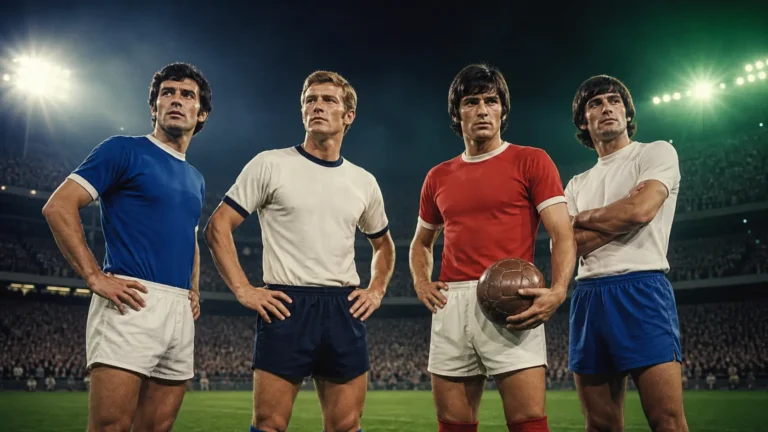
The best football players of the 1970s shaped a decade that changed how the game was played. Ajax brought Total Football to the top of Europe. Bayern Munich followed with its own run of European success. Brazil won one of the most famous World Cups ever, West Germany became world champion on home soil, and Argentina won its first title in 1978. The decade also produced elite stars in every part of the field.
For this ranking, we counted only performances from January 1970 through December 1979. We compared peak level, major international tournaments, European club success, individual awards, consistency, and each player’s role. Achievements from the 1960s or 1980s do not increase a player’s score. That gives us a fairer way to compare Johan Cruyff, Franz Beckenbauer, Gerd Müller, Pelé, Kevin Keegan, and the other leading footballers of the decade.
Key Takeaways
- Johan Cruyff ranks as our best football player of the 1970s.
- Franz Beckenbauer is second after winning the World Cup, EURO, three European Cups, and two Ballon d’Or awards during the decade.
- Gerd Müller ranks third after elite scoring for Bayern Munich and West Germany.
- Pelé’s 1970 World Cup keeps him high despite playing only part of the decade at his peak.
- Kevin Keegan finished the 1970s with back-to-back Ballon d’Or awards.
- Only performances from 1970 through 1979 count toward this ranking.
Top 10 Best Football Players of the 1970s
| Rank | Player | Country | Main Position | Key 1970s Achievement | FootballerRank Decade Rating |
| 1 | Johan Cruyff | Netherlands | Forward / Playmaker | Three European Cups and three Ballon d’Or awards | 99/100 |
| 2 | Franz Beckenbauer | West Germany | Defender / Libero | 1974 World Cup and three European Cups | 98/100 |
| 3 | Gerd Müller | West Germany | Striker | 1970 Ballon d’Or and 1974 World Cup winner | 96/100 |
| 4 | Kevin Keegan | England | Forward | 1977 European Cup and two Ballon d’Or awards | 93/100 |
| 5 | Pelé | Brazil | Forward | 1970 World Cup champion | 92/100 |
| 6 | Mario Kempes | Argentina | Forward | 1978 World Cup Golden Ball and top scorer | 91/100 |
| 7 | Oleh Blokhin | Soviet Union | Forward / Winger | 1975 Ballon d’Or and European success | 90/100 |
| 8 | Jairzinho | Brazil | Winger / Forward | Scored in every Brazil game at the 1970 World Cup | 89/100 |
| 9 | Johan Neeskens | Netherlands | Midfielder | Three European Cups and two World Cup finals | 88/100 |
| 10 | Dino Zoff | Italy | Goalkeeper | 1,142-minute international clean-sheet record | 87/100 |
FootballerRank Decade Ratings are editorial scores. They are not official FIFA, UEFA, or Ballon d’Or ratings.
How We Ranked the Best Players of the 1970s
This is a decade ranking, not a career ranking.
A player who became much better in the 1980s does not receive extra credit here. The same applies to stars whose greatest achievements came in the 1960s.
We use six main factors:
| Ranking Factor | Weight | What We Considered |
| Peak performance from 1970–1979 | 25% | How strong the player was at his best |
| Major international impact | 20% | World Cups and European Championships |
| Major club success | 20% | European Cups, league titles, and other major trophies |
| Individual recognition | 15% | Ballon d’Or and period-specific awards |
| Consistency across the decade | 10% | How long the player remained near his peak |
| Position and team influence | 10% | Value within the player’s role |
The Ballon d’Or also needs context.
During the 1970s, the award was still limited by eligibility rules that did not give South American players the same opportunity as European players.
So Pelé and Jairzinho are not marked down simply because they did not win the Ballon d’Or.
1. Johan Cruyff
Country: Netherlands
Main clubs in the decade: Ajax, Barcelona
Position: Forward / Playmaker
FootballerRank Decade Rating: 99/100
Johan Cruyff is our choice as the best football player of the 1970s.
His first major argument comes from Ajax.
The Dutch club won three straight European Cups in 1971, 1972, and 1973. Cruyff was the leading attacking figure in the team and the player most closely linked with Ajax’s Total Football system.
He scored twice as Ajax beat Inter Milan 2-0 in the 1972 European Cup final.
His individual awards were just as strong.
Cruyff won the Ballon d’Or in 1971, 1973, and 1974, becoming the first player to win the award three times.
He then moved to Barcelona and helped the club win its first Spanish league title in 14 years.
The 1974 World Cup added another major part to his decade. Cruyff led the Netherlands to the final while Total Football gained global attention. West Germany eventually won 2-1.
Cruyff’s value came from more than goals. He moved between positions, created space, carried the ball, passed, scored, and helped direct the attack.
Why he ranks No. 1: Three European Cups, three Ballon d’Or awards, a World Cup final, and his role in Total Football give Cruyff the strongest complete 1970s case.
2. Franz Beckenbauer
Country: West Germany
Main club: Bayern Munich
Position: Defender / Libero
FootballerRank Decade Rating: 98/100
Franz Beckenbauer has one of the strongest decade records of any defender in football history.
His international success started with the 1972 European Championship.
West Germany won the tournament, and Beckenbauer was the team’s leader from his libero role. He also won the Ballon d’Or that year.
Two years later, he captained West Germany to the 1974 World Cup title.
They beat Cruyff’s Netherlands 2-1 in the final in Munich.
His Bayern Munich record makes the argument even stronger.
Bayern won three straight European Cups from 1974 through 1976, replacing Ajax as Europe’s leading club team. Beckenbauer won his second Ballon d’Or in 1976.
Beckenbauer helped change how the libero position was played. He could defend but also move forward with the ball and start attacks.
Why he ranks No. 2: A World Cup, EURO title, three European Cups, and two Ballon d’Or awards give Beckenbauer an exceptional decade.
3. Gerd Müller
Country: West Germany
Main club: Bayern Munich
Position: Striker
FootballerRank Decade Rating: 96/100
Gerd Müller was the defining goalscorer of the early and middle 1970s.
He started the decade with an outstanding World Cup.
Müller scored 10 goals at the 1970 World Cup, including two in West Germany’s famous 4-3 semi-final defeat to Italy.
He won the 1970 Ballon d’Or.
Two years later, Müller helped West Germany win EURO 1972. He scored twice in the final against the Soviet Union.
The biggest international moment came in 1974.
West Germany reached the World Cup final against the Netherlands. With the score at 1-1, Müller scored what became the winning goal. Germany won 2-1.
At club level, he was part of Bayern’s three straight European Cup-winning teams.
Müller’s movement inside the penalty area was his great strength. He could find space quickly and finish chances before defenders reacted.
Why he ranks No. 3: Müller paired elite scoring with a Ballon d’Or, EURO title, World Cup title, and three European Cups.
4. Kevin Keegan
Country: England
Main clubs: Liverpool, Hamburg
Position: Forward
FootballerRank Decade Rating: 93/100
Kevin Keegan built one of the strongest club records of the decade.
At Liverpool, he won English league titles in 1973, 1976, and 1977.
He also won two UEFA Cups, the FA Cup, and the 1977 European Cup.
Keegan then moved to Hamburg in Germany.
After a difficult start, he helped Hamburg win the Bundesliga in 1979.
His individual recognition separates him from many other late-decade stars.
Keegan won the Ballon d’Or in both 1978 and 1979.
His international record was not as strong as Cruyff’s, Beckenbauer’s, Müller’s, or Pelé’s. England failed to qualify for the 1974 and 1978 World Cups.
That is the main reason he does not reach our top three.
Why he ranks No. 4: Keegan combined major success in England and Germany with the European Cup and back-to-back Ballon d’Or awards.
5. Pelé
Country: Brazil
Main clubs in the decade: Santos, New York Cosmos
Position: Forward
FootballerRank Decade Rating: 92/100
Pelé’s greatest career years began before the 1970s, so this ranking does not use his 1958 or 1962 World Cup titles.
His 1970 achievements alone are still strong enough to place him fifth.
Brazil won all six matches at the 1970 World Cup in Mexico and scored 19 goals.
Pelé scored in the final as Brazil beat Italy 4-1.
He also supplied the final pass for Carlos Alberto’s famous fourth goal. The move remains one of the best-known team goals in World Cup history.
Pelé’s role was different from his younger years.
He still scored, but his passing and link play helped connect Brazil’s group of attacking players.
He later moved to the New York Cosmos and helped grow interest in soccer in the United States before retiring in 1977.
Why is he only fifth?
This list covers the full decade. Cruyff, Beckenbauer, Müller, and Keegan produced more elite evidence across several years of the 1970s.
Why he ranks No. 5: Pelé’s 1970 World Cup was a great final chapter at international level, but much of his all-time case belongs to earlier decades.
6. Mario Kempes
Country: Argentina
Main clubs: Rosario Central, Valencia
Position: Forward
FootballerRank Decade Rating: 91/100
Mario Kempes produced the defining individual performance of the 1978 World Cup.
Argentina hosted the tournament and entered the final against the Netherlands looking for its first men’s World Cup title.
Kempes delivered.
He scored twice in the final as Argentina won 3-1 after extra time.
He finished the tournament with six goals.
Kempes was also the tournament’s leading scorer and Golden Ball winner.
His club form was strong too.
He became a major scorer for Valencia in Spain and won consecutive Pichichi trophies as La Liga’s leading scorer before the World Cup.
His 1978 peak is as strong as almost anyone’s in the decade.
He ranks below the first five because their top-level evidence covered a larger part of the 1970s.
Why he ranks No. 6: Kempes was the leading scorer and best player at the tournament that gave Argentina its first World Cup.
7. Oleh Blokhin
Country: Soviet Union
Main club: Dynamo Kyiv
Position: Forward / Winger
FootballerRank Decade Rating: 90/100
Oleh Blokhin reached his peak in the middle of the decade.
The year 1975 was especially strong.
Dynamo Kyiv became the first Soviet club to win a major European competition when it lifted the European Cup Winners’ Cup.
Blokhin then produced one of the decade’s best European performances against Bayern Munich in the UEFA Super Cup.
He scored all three goals over the two legs as Dynamo beat the European champions 3-0 on aggregate.
His performances earned him the 1975 Ballon d’Or.
Blokhin was very quick and dangerous when he had space to attack. He could move from wide positions toward goal and finish attacks himself.
His main weakness in this ranking is international tournament success.
The Soviet Union did not qualify for either the 1974 or 1978 World Cups.
Why he ranks No. 7: Blokhin’s 1975 European season and Ballon d’Or give him one of the decade’s strongest individual peaks.
8. Jairzinho
Country: Brazil
Main club in most of the decade: Botafogo
Position: Winger / Forward
FootballerRank Decade Rating: 89/100
Jairzinho began the decade with one of the greatest scoring runs in World Cup history.
He scored seven goals at the 1970 World Cup.
More impressively, he scored in all six matches Brazil played on the way to the title.
His goals came against:
- Czechoslovakia
- England
- Romania
- Peru
- Uruguay
- Italy
Jairzinho scored again at the 1974 World Cup and remained an important player for Brazil during the decade.
His style mixed speed with physical strength. He could attack defenders directly but was also comfortable moving into central scoring areas.
Why he ranks No. 8: Scoring in every match of Brazil’s 1970 World Cup-winning run gives Jairzinho a place among the decade’s defining attackers.
9. Johan Neeskens
Country: Netherlands
Main clubs: Ajax, Barcelona
Position: Midfielder
FootballerRank Decade Rating: 88/100
Johan Neeskens played a major role in both Ajax’s club dominance and the Netherlands’ international rise.
He was part of the Ajax team that won three straight European Cups from 1971 through 1973.
His World Cup record adds even more.
Neeskens scored five times at the 1974 World Cup.
In the final, he gave the Netherlands the lead from the penalty spot after only 88 seconds.
He also played in the Netherlands team that reached another World Cup final in 1978.
That gives him two World Cup runner-up finishes in the same decade.
Neeskens could defend, press, run beyond the forwards, and score. That made him an ideal midfielder for Total Football.
Why he ranks No. 9: Three European Cups and two World Cup finals give Neeskens a strong club and international record across the decade.
10. Dino Zoff
Country: Italy
Main clubs: Napoli, Juventus
Position: Goalkeeper
FootballerRank Decade Rating: 87/100
Dino Zoff completes the Top 10 and gives the ranking an elite goalkeeper.
His most famous 1970s record came with Italy.
Between 1972 and 1974, Zoff went 1,142 consecutive minutes without conceding an international goal.
His performances also earned strong individual recognition.
Zoff finished second in the 1973 Ballon d’Or voting.
At Juventus, he won several Serie A titles during the decade.
He also helped Juventus win the 1977 UEFA Cup.
His greatest international trophy came in the 1980s, so it does not count here.
Why he ranks No. 10: Zoff combined exceptional consistency, a historic unbeaten run, league success, and UEFA Cup victory during the 1970s.
Who Was the Best Football Player of the 1970s?
Johan Cruyff was the best football player of the 1970s in our ranking.
His decade included three European Cups with Ajax, three Ballon d’Or awards, a Spanish league title with Barcelona, and a run to the 1974 World Cup final.
Franz Beckenbauer is a very close second.
His argument includes the 1972 European Championship, the 1974 World Cup, three European Cups with Bayern, and two Ballon d’Or awards.
Gerd Müller completes our top three after elite scoring for the same West Germany and Bayern teams.
What Made 1970s Football Special?
The decade produced major tactical and competitive changes.
Total Football reached the top of Europe
Ajax won the European Cup in 1971, 1972, and 1973.
Cruyff was the best-known player, but Neeskens, Ruud Krol, Johnny Rep, and other teammates played major roles.
Players exchanged positions instead of staying fixed in one area.
Bayern replaced Ajax as Europe’s dominant team
Bayern Munich then won three straight European Cups from 1974 through 1976.
Beckenbauer controlled the team from defence, while Müller provided the goals.
English clubs took control late in the decade
Liverpool won the European Cup in 1977 and 1978.
Nottingham Forest then won in 1979.
The World Cup also produced three different champions during the decade:
- Brazil in 1970
- West Germany in 1974
- Argentina in 1978
Each tournament produced players who appear in this Top 10.
FAQs
Who were the top three football players of the 1970s?
Our top three are Johan Cruyff, Franz Beckenbauer, and Gerd Müller. Cruyff leads because of his three Ballon d’Or awards, Ajax’s European success, and his influence on Total Football.
Was Pelé the best football player of the 1970s?
Not across the full decade. Pelé was outstanding at the 1970 World Cup, but much of his greatest career work happened during the 1950s and 1960s. We rank him fifth for the 1970s only.
Was Cruyff better than Beckenbauer in the 1970s?
Our ranking gives Cruyff a very small edge. Cruyff won three Ballon d’Or awards and led Ajax to three European Cups. Beckenbauer had the stronger international trophy record after winning EURO 1972 and the 1974 World Cup.
Who scored the most goals at the 1970 World Cup?
Gerd Müller scored 10 goals for West Germany. Jairzinho scored seven for champion Brazil and found the net in every match his team played.
Who was the best goalkeeper of the 1970s?
Dino Zoff is our highest-ranked goalkeeper. His 1,142-minute international run without conceding and his long-term success with Juventus give him the strongest case.
Why is Zico not in the Top 10?
Zico was already becoming a major player during the late 1970s, but more of his strongest club and international evidence falls in the 1980s. He has a much stronger case in that decade’s ranking.
Why is Diego Maradona not in the Top 10?
Maradona made his senior debut in the 1970s and was already an exceptional young player in Argentina. However, most of his defining international and European achievements came in the 1980s. We do not use those later achievements here.
Who just missed the Top 10?
Roberto Rivelino was one of the closest omissions. He played at three World Cups during the decade, winning in 1970, finishing fourth in 1974, and third in 1978.
Sepp Maier, Ruud Krol, Grzegorz Lato, Carlos Alberto, and Allan Simonsen also had strong cases.
Does this ranking include achievements from 1980?
No. The cutoff is December 31, 1979. Anything from January 1980 belongs to the next decade.
Sources and Fact-Checking
This ranking was checked against historical tournament records, European competition records, Ballon d’Or history, club records, and World Cup data.
FootballerRank uses a strict rule for decade articles. Only evidence from 1970 through 1979 decides this ranking. Later achievements can provide background, but they do not improve a player’s place here.
Conclusion
After comparing performances from 1970 through 1979 only, Johan Cruyff has the strongest case as the decade’s best football player. Beckenbauer combined defensive skill with huge success for club and country, while Müller provided the goals behind many of those German victories. Keegan, Pelé, Kempes, Blokhin, Jairzinho, Neeskens, and Zoff complete a Top 10 that reflects the decade’s different styles and positions. Keeping later achievements out of the scoring also makes the ranking fairer, because every player is judged for what he actually did during the 1970s.