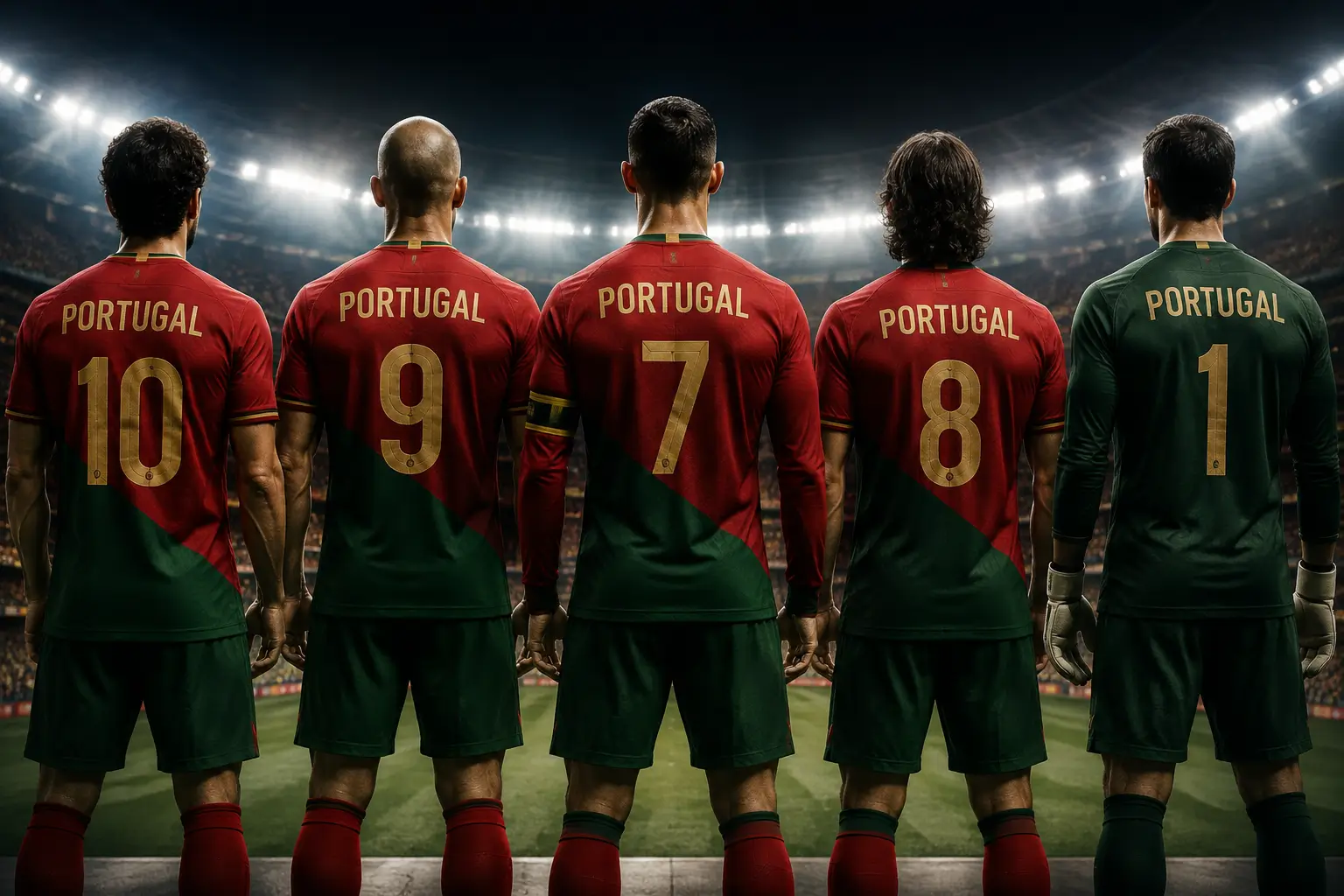
Cristiano Ronaldo leads our ranking of the best Portuguese football players of all time. His scoring record, five Ballon d’Or awards and long career at the highest level give him the strongest overall case. Eusébio is second for his outstanding Benfica career and his nine-goal performance at the 1966 World Cup. Luís Figo completes the top three through his creative quality, club success and influence for Portugal.
Portugal has produced great forwards, midfielders and defenders across very different eras. This 2026 edition compares their individual level, sustained contribution, national-team performances and club careers. The order is FootballerRank’s editorial judgment. The records explain each selection, but no single goal total or trophy count can fully compare a winger with a centre back.
Key Takeaways
- Ronaldo ranks first, followed by Eusébio and Figo.
- Eligibility depends on representing Portugal, so birthplace does not exclude Eusébio, Coluna, Pepe or Deco.
- Pepe is our highest-ranked defender, with his Euro 2016 final performance central to his case.
- Rui Costa narrowly leads Deco through his longer creative contribution for Portugal; Deco has the stronger European club trophy record.
- Moutinho takes the final place through sustained national-team service and his contribution to Portugal’s first major title.
The Top 10 Portuguese Football Players
| Rank | Player | Main role | Strongest evidence |
| 1 | Cristiano Ronaldo | Forward | Record Portugal scorer; five Ballon d’Or awards |
| 2 | Eusébio | Striker | 1965 Ballon d’Or; nine goals at the 1966 World Cup |
| 3 | Luís Figo | Winger | 2000 Ballon d’Or; creative influence across leading clubs |
| 4 | Mário Coluna | Midfielder | Two European Cups; goals in both winning finals |
| 5 | Pepe | Centre back | Euro 2016 final player of the match |
| 6 | Rui Costa | Attacking midfielder | 94 Portugal appearances; long creative career |
| 7 | Deco | Midfielder | Two Champions League wins with different clubs |
| 8 | Paulo Futre | Winger | 1987 European Cup; second in that year’s Ballon d’Or |
| 9 | Ricardo Carvalho | Centre back | Porto European success; three Premier League titles |
| 10 | João Moutinho | Central midfielder | 146 Portugal appearances; Euro 2016 winner |
How We Rank the Players?
This list covers senior men’s players who represented Portugal. It includes internationals born outside the country. Eusébio and Coluna were born in Mozambique; Pepe and Deco were born in Brazil. Their Portugal careers make them eligible under the same rule as every other player here.
Individual peak and sustained influence carry the greatest weight. Portugal performances matter strongly because this is a country ranking. Club football adds evidence from many more matches, including domestic leagues and European competition. We assess what a player contributed instead of giving equal credit to everyone in a winning squad.
| Factor | What we assess |
| Individual peak | The player’s strongest level within his position and era |
| Career length | How long he made a substantial contribution |
| Portugal influence | Tournament performances, major matches and responsibility |
| Club contribution | Regular performance and role in leading competitions |
| Context | Position, teammates, competition and differences between eras |
There is no points formula presented as an official result. Close places can change if a reader values club peak more than national-team longevity. Active players are assessed on achievements already earned. A future title or expected career finish receives no credit.
1. Cristiano Ronaldo
Ronaldo combines a very high peak with exceptional longevity. He developed from a winger who beat defenders into a forward who could decide matches through movement, finishing and heading. That change helped him keep scoring after the early part of his career, when dribbling and pace were more central to his game.
UEFA’s checked 2026 record lists 146 goals in 234 Portugal appearances. These are active totals, so they can change. His club career includes five Champions League winning campaigns, one with Manchester United and four with Real Madrid. Five Ballon d’Or awards provide further evidence of his standing across several years.
Ronaldo captained Portugal to the Euro 2016 title, although injury forced him off early in the final. His tournament contribution should be separated from the decisive final goal, which Éder scored. Ronaldo also helped Portugal win the Nations League in 2019 and 2025. In the 2025 final, he scored the second equaliser in a 2–2 draw with Spain before Portugal won the shootout.
He ranks first because his best level lasted across a larger body of elite club football and Portugal matches than any other player here. Eusébio’s 1966 World Cup remains an outstanding individual tournament, but Ronaldo has the stronger complete-career case. His international scoring record supports that decision without being its only basis.
For the wider comparison, read our Messi vs Ronaldo analysis.
2. Eusébio
Eusébio remains Portugal’s greatest historical striker. His pace, direct running and strong finishing made him dangerous from several attacking situations. He could attack space, carry the ball forward and strike before a defence had time to settle. His record reflects a player who could dominate both domestic football and major international matches.
At the 1966 World Cup, Eusébio scored nine goals and won the Golden Boot as Portugal finished third. His four goals against North Korea turned a 3–0 deficit into a 5–3 quarterfinal victory. That comeback gives his tournament record a clear match context: his scoring changed the result when Portugal faced elimination.
He won the 1965 Ballon d’Or and helped Benfica win the 1962 European Cup. In that final, he scored twice as Benfica beat Real Madrid 5–3. His Portugal career ended with 41 goals in 64 appearances, an outstanding return that should be read alongside the smaller international schedules of his era.
Eusébio ranks above Figo because of his stronger individual scoring impact and his exceptional World Cup performance. His place does not rest on nostalgia. The award, European final and national-team record offer separate evidence of his quality. Ronaldo leads through a longer elite career, but Eusébio’s peak keeps the comparison serious.
3. Luís Figo
Figo gave Portugal an attacker who could create chances without needing to score them himself. He carried the ball past opponents, supplied crosses and drew defenders out of shape. His value was visible in the options he gave teammates, especially when a match needed an accurate final pass or a change of attacking direction.
His career took him through Sporting, Barcelona, Real Madrid and Inter. The 2000 Ballon d’Or recognised his individual level, while the Champions League winning campaign ending in 2002 added a leading European club achievement. Success across several clubs strengthens his case beyond one system or one group of teammates.
For Portugal, Figo made 127 appearances and scored 32 goals. He helped the team reach the Euro 2000 semifinals, the Euro 2004 final and fourth place at the 2006 World Cup. Portugal did not win those tournaments, but those runs remain meaningful evidence of his international contribution.
Figo takes third because he combines an outstanding individual peak with a long creative career. Coluna had more European Cup final success, but Figo’s attacking influence and top individual award give him the edge in this ranking. Comparing their roles requires more than counting goals or medals.
4. Mário Coluna
Coluna was central to the Benfica team that won consecutive European Cups in 1961 and 1962. He scored in both finals. That detail matters because it connects the honours to his own contribution instead of treating him simply as a member of a successful squad.
He brought physical presence, passing and attacking support to midfield. Benfica’s forwards received much of the attention, but Coluna helped the team connect its play and compete through the middle. His ability to influence several parts of a match gives him a broader case than his eight Portugal goals might suggest.
Coluna made 57 appearances for Portugal and was a leading figure in the side that finished third at the 1966 World Cup. His midfield work complemented Eusébio’s scoring. The two players contributed in different ways to the same important period in Portuguese football.
He ranks fourth because his European peak and influence in Portugal’s first World Cup finals were both substantial. Modern players have more international matches available, so his cap total cannot be compared directly with Moutinho’s. Coluna’s role and major-match evidence carry more weight than the size of his schedule.
5. Pepe
Pepe has the strongest defensive case in this list. He combined close marking, recovery speed and aerial strength with the ability to protect the penalty area under pressure. His long career also shows that his value lasted beyond the period when speed could cover more mistakes.
He was part of three Real Madrid Champions League winning campaigns. Winning a campaign is different from playing in its final, so those honours should not be described as three final appearances. His club work gives evidence of sustained performance in a position where errors are often more visible than successful decisions.
Pepe’s clearest Portugal achievement came in the Euro 2016 final. UEFA named him player of the match after Portugal beat France 1–0 in extra time. That award supports a specific defensive performance in the country’s first major senior men’s title. He also won the 2019 Nations League and finished his international career with 141 appearances and eight goals.
He ranks above Rui Costa because of his long defensive contribution and his direct influence in Portugal’s title-winning final. This does not reduce the importance of creative midfielders. It recognises that preventing chances can decide major matches just as clearly as making them. Pepe retired in 2024.
6. Rui Costa
Rui Costa was one of Portugal’s finest creative midfielders. He could find space between opposing lines, receive the ball under pressure and release a teammate with a well-timed pass. His control of the final ball helped attacks develop without needing every move to depend on an individual dribble.
His main club years came at Benfica, Fiorentina and AC Milan. He won the Champions League with Milan in the campaign ending in 2003 and the Italian league in 2004. Those achievements add to a career whose strongest evidence often lies in chance creation and attacking organisation.
For Portugal, Rui Costa scored 26 goals in 94 appearances. He helped the team reach the Euro 2000 semifinals and the Euro 2004 final. His goal total is useful supporting evidence, but it does not measure all the chances he created or the space his passing opened for others.
He narrowly ranks above Deco because this country list gives substantial weight to his longer creative contribution for Portugal. Deco’s two Champions League wins create a stronger European club trophy case. A ranking focused mainly on club football could reasonably reverse them. Sixth place reflects the balance used here, rather than a claim that Rui Costa wins every comparison.
7. Deco
Deco could create chances, keep possession and help a team change the pace of a match. He offered more than a final pass. His work connected midfield to attack, allowing teammates to move into better positions while the ball stayed under control.
He helped Porto win the UEFA Cup in 2003 and the Champions League in 2004. In the latter final, he scored Porto’s second goal in a 3–0 victory over Monaco and received the player-of-the-match award. He then won another Champions League with Barcelona in the campaign ending in 2006.
Born in Brazil, Deco became eligible for Portugal and scored the winning goal against Brazil on his international debut in 2003. He finished with 75 appearances and five goals. He was part of Portugal’s Euro 2004 runner-up side and the team that finished fourth at the 2006 World Cup.
Deco ranks seventh because his European peak is among the strongest in this group, while his Portugal career was shorter than Rui Costa’s. His selection also shows why birthplace is not the rule used here. Once a player represented Portugal, we assess the career and contribution on the same basis as other eligible internationals.
8. Paulo Futre
Futre was a direct winger whose close control and acceleration made him difficult to stop in one-on-one situations. He could carry an attack forward himself, making defenders retreat and opening space for teammates. That individual threat is the main reason his peak earns a top-ten place.
He helped Porto win the 1987 European Cup, beating Bayern Munich 2–1 in the final. Futre finished second in the Ballon d’Or that year. He later became an important player at Atlético Madrid, where his attacking ability gave him a strong reputation beyond Portuguese club football.
His Portugal record was 41 appearances and six goals. It is smaller than the international records of many players above him, and injuries limited his career. Those limits matter, but they do not remove the evidence of how good he was at his best.
Futre ranks eighth because this method gives a high individual peak meaningful weight. Carvalho and Moutinho have stronger longevity arguments. Futre leads them through his exceptional attacking level and the recognition it earned. He sits below Deco because Deco combines a strong peak with a broader record of major club and Portugal contribution.
9. Ricardo Carvalho
Carvalho built his game around reading danger, choosing the right moment to challenge and keeping the defensive line organised. His positioning often reduced the need for a last-second tackle. That made him an effective partner for defenders whose style depended more on direct physical contests.
He helped Porto win the 2003 UEFA Cup and the 2004 Champions League before moving to Chelsea. There, he won three Premier League titles. His later Real Madrid career adds another leading-club setting in which he contributed, giving his record depth beyond Porto’s European success.
Carvalho made 89 Portugal appearances and scored five goals. He played in the Euro 2004 runner-up side and the team that finished fourth at the 2006 World Cup. He also belonged to Portugal’s Euro 2016 winning squad, playing in the group stage. He did not play in that final, so his winner’s medal should not be presented as a final performance.
He ranks ninth through the quality and length of his defensive career. Pepe leads their comparison here because of his longer Portugal service and outstanding 2016 final. Carvalho still belongs in the top ten because his club record and international work offer a strong combined case.
10. João Moutinho
Moutinho’s value came from reliable passing, movement and support for teammates. He helped midfield stay connected, offered an option for the ball and worked to keep the team organised when possession changed. His role was less visible than that of a scorer or dribbling winger, but it supported both attack and defence.
His club career included Sporting, Porto, Monaco and Wolves. League success with Porto and Monaco shows that his contribution carried across different teams and competitions. The national-team record is especially important to his place in this country ranking.
Moutinho made 146 Portugal appearances and scored seven goals. He won Euro 2016 and the 2019 Nations League. He appeared as a substitute in the Euro 2016 final, contributing to the team that secured Portugal’s first major senior men’s title. That does not mean he played every match of the tournament.
He takes tenth through sustained Portugal service and meaningful work during the title-winning period. Bernardo Silva has a stronger case for club peak, while Nani offers a more direct Euro 2016 scoring argument. Moutinho’s selection is a close editorial choice based on the balance of longevity, midfield responsibility and national-team contribution.
Portugal Records at a Glance
These figures compare international careers, rather than providing another ranking. The table uses checked figures for this 2026 edition. Ronaldo’s total remains active and can change after publication. Goals are more central to the roles of Ronaldo and Eusébio than to those of the defenders or deeper midfielders.
| Player | Portugal appearances | Portugal goals |
| Cristiano Ronaldo | 234* | 146* |
| Eusébio | 64 | 41 |
| Luís Figo | 127 | 32 |
| Mário Coluna | 57 | 8 |
| Pepe | 141 | 8 |
| Rui Costa | 94 | 26 |
| Deco | 75 | 5 |
| Paulo Futre | 41 | 6 |
| Ricardo Carvalho | 89 | 5 |
| João Moutinho | 146 | 7 |
*Active record checked for the 2026 edition. FPF, UEFA and RSSSF support the international figures. Appearance totals reflect senior national-team matches.
Players Close to the Top 10
Bernardo Silva is the closest active challenger to the final place. His Manchester City career and the 2019 Nations League Player of the Tournament award give him a strong case. Moutinho leads narrowly under this article’s weighting of sustained Portugal service and contribution to Euro 2016. A list that prioritises club peak could place Bernardo higher now.
Nani also deserves serious consideration. His three goals at Euro 2016 and sustained attacking contribution for Portugal make him a direct rival for inclusion. Bruno Fernandes has a strong creative and scoring record, but his place must be based on work already completed, with no credit given for expected future honours.
Pauleta’s 47 goals in 88 appearances give him an important national-team scoring case. Goalkeeper Vítor Baía and winger Fernando Chalana offer different arguments through club success and individual quality. No goalkeeper makes this ten, but that is a result of the close career comparisons rather than a rule excluding the position.
For more national selections, explore our best football players by country.
Frequently Asked Questions
Who is the best Portuguese football player of all time?
Cristiano Ronaldo ranks first here. His individual peak, five Ballon d’Or awards, long elite club career and record Portugal scoring combine to give him the strongest overall case. Eusébio ranks second, with Figo third.
Why is Eusébio above Luís Figo?
Eusébio’s nine-goal 1966 World Cup, 1965 Ballon d’Or and decisive scoring in Benfica’s 1962 European Cup final give him the edge. Figo offers exceptional creative quality and longevity, but Eusébio’s strongest performances had a greater direct scoring impact.
Can players born outside Portugal qualify for this list?
Yes. Eligibility depends on representing Portugal’s senior men’s team. Eusébio, Coluna, Pepe and Deco qualify despite being born outside Portugal. The rule applies consistently across the selection.
Why does Rui Costa rank above Deco?
Rui Costa leads narrowly because this ranking gives substantial weight to his longer creative Portugal career. Deco has the stronger European club trophy record and could lead in a comparison that gives more weight to club football.
Why is Moutinho ahead of Bernardo Silva?
Moutinho takes the final place through 146 Portugal appearances and his contribution to the Euro 2016 and 2019 Nations League winning teams. Bernardo has a stronger club-peak argument and was the best player at the 2019 Nations League. The choice is close and depends on the stated ranking balance.
Sources and Fact Checking
UEFA supports Ronaldo’s checked international total, the European competition achievements, Pepe’s Euro 2016 final award and Bernardo Silva’s 2019 Nations League award. FPF supplies Portugal player records, including Moutinho’s appearances and Pepe’s completed career. RSSSF provides an additional comparison of historical Portugal caps and goals.
The English FA’s historical coverage supports Eusébio’s 1966 World Cup record. Benfica’s history supports Coluna and Eusébio’s European Cup final contributions. Chelsea supports Carvalho’s Premier League honours, AC Milan supports Rui Costa’s club achievements, and Futre’s official biography supports his 1987 European success. France Football and UEFA support the cited Ballon d’Or evidence. These sources establish the facts; FootballerRank sets the order.
Conclusion
In short, Ronaldo leads our best Portuguese football players of all time ranking, with Eusébio and Figo completing the top three. Coluna’s midfield influence, Pepe’s defensive career and the creative work of Rui Costa and Deco give the list depth across roles and eras. Futre, Carvalho and Moutinho complete a closely matched final group. The strongest comparisons use individual quality, career length and actual club and Portugal contribution together. Clear eligibility and source notes make the close choices easier to assess without treating a trophy count or scoring table as the whole answer.