The football players with most career goals include Cristiano Ronaldo, Lionel Messi, Pelé, Romário, Ferenc Puskás, Josef Bican, Robert Lewandowski, and other legendary scorers from very different eras. Comparing them is not as simple as finding the largest number online because older career totals often include friendlies, regional competitions, reserve matches, or other games that modern statistical databases treat differently.
FootballerRank therefore uses a consistent top-level official senior methodology for the main ranking. We count recognized senior club league, cup, continental, and senior international goals while excluding youth, reserve, and ordinary exhibition matches. Active-player totals are updated separately because they can change every week. Using that approach, Cristiano Ronaldo is the highest career goalscorer in men’s top-level football history with 979 goals as of September 13, 2026, ahead of Lionel Messi on 928.
Last reviewed: September 13, 2026
Key Takeaways
- Cristiano Ronaldo leads our official senior career-goals ranking with 979 goals.
- Lionel Messi ranks second with 928 after scoring again for Inter Miami on September 12, 2026.
- Pelé ranks third under this top-level official methodology with 762 goals.
- Robert Lewandowski is the third active player in the Top 10 and has passed 700 official senior goals.
- Historical totals for Pelé, Josef Bican, Romário, and several older scorers vary greatly depending on which competitions and friendlies are included.
- This page counts career goals only; dedicated FootballerRank pages separately cover international, World Cup, and Champions League goals.
Top 10 Football Players With Most Career Goals
| Rank | Player | Country | Official Senior Goals | Career | Status |
| 1 | Cristiano Ronaldo | Portugal | 979 | 2002–present | Active |
| 2 | Lionel Messi | Argentina | 928 | 2004–present | Active |
| 3 | Pelé | Brazil | 762 | 1957–1977 | Retired |
| 4 | Romário | Brazil | 756 | 1985–2007 | Retired |
| 5 | Ferenc Puskás | Hungary / Spain | 725 | 1943–1966 | Retired |
| 6 | Josef Bican | Austria / Czechoslovakia | 722 | 1931–1955 | Retired |
| 7 | Robert Lewandowski | Poland | 704 | 2008–present | Active |
| 8 | Jimmy Jones | Northern Ireland | 639 | 1947–1964 | Retired |
| 9 | Gerd Müller | West Germany | 634 | 1964–1981 | Retired |
| 10 | Joe Bambrick | Northern Ireland | 626 | 1926–1943 | Retired |
Active totals can change after every competitive match. Historical figures use the same top-level official competition methodology throughout the main table.
Who Has Scored the Most Career Goals in Football History?
Cristiano Ronaldo has scored the most top-level official senior career goals in men’s football history.
As of September 13, 2026, our verified total places him on:
979 official senior goals
That combines goals for his senior clubs and Portugal.
Ronaldo remains active with Al Nassr at age 41.
He is therefore only:
21 goals away from 1,000
under this counting method.
That makes his total different from a fixed historical record.
Every new official goal can increase the benchmark.
What Counts as an Official Career Goal?
This is the most important question on the page.
Football history contains several competing career-goal lists because researchers do not always count the same matches.
FootballerRank’s main table includes goals from recognized senior first-team competitions.
Club goals included
We count goals from competitions such as:
- National top-level leagues
- Recognized domestic cups
- Domestic league cups
- Official super cups
- Continental club competitions
- FIFA or recognized intercontinental club competitions
- Other recognized top-level first-team tournaments
International goals included
We count recognized senior national-team goals from:
- FIFA World Cup
- World Cup qualifiers
- Continental championships
- Continental qualifiers
- Nations League-type competitions
- Recognized senior international friendlies
- Other recognized senior internationals
Goals excluded from the main ranking
We do not add:
- Youth-team goals
- Reserve-team goals
- Training games
- Testimonial matches
- Ordinary club friendlies
- Exhibition-tour matches
- Unverified unofficial matches
That consistent definition is essential when comparing players from different eras.
Why Do Different Websites Show Different Career Goal Totals?
Because there is no single FIFA-maintained all-time career-goals table covering every player in football history.
Historical researchers use different definitions.
One database may count only top-level official competitions.
Another may include:
- Regional leagues
- Lower divisions
- Wartime competitions
- Representative matches
- Selected friendlies
Another may count virtually every documented senior match.
This is why the same player can have several widely published career totals.
The disagreement is especially important for:
- Josef Bican
- Pelé
- Romário
- Ferenc Puskás
- Older British and European scorers
FootballerRank does not hide that disagreement.
We choose one methodology for the ranking and explain the alternatives separately.
1. Cristiano Ronaldo — 979 Goals
Country: Portugal
Career: 2002–present
Official senior goals: 979
Status: Active
Cristiano Ronaldo is the current leader for the most career goals in football under our top-level official senior methodology.
His career has taken him through:
- Sporting CP
- Manchester United
- Real Madrid
- Juventus
- Al Nassr
- Portugal
The largest part of his club total came at Real Madrid.
Ronaldo scored 450 goals in 438 competitive matches for the Spanish club.
That made him Real Madrid’s all-time leading scorer.
He also became the UEFA Champions League’s record scorer.
His international total is just as historic.
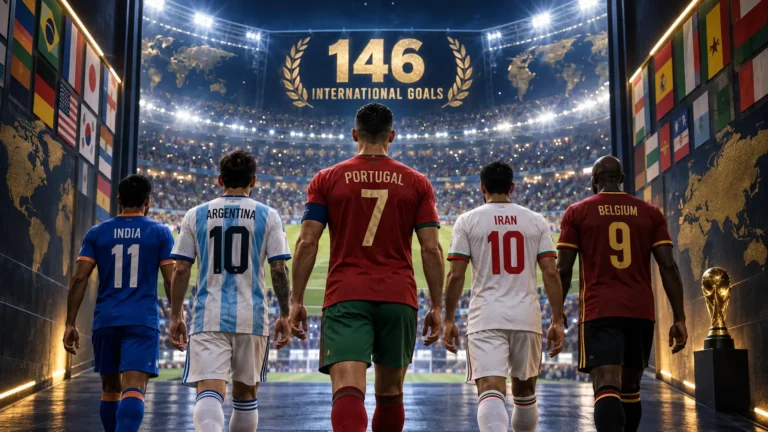
Ronaldo has scored 146 goals for Portugal, the men’s international world record.
Those international goals are included in his career total here, but the full international ranking belongs on our dedicated Football Players With Most International Goals page.
The remarkable part is longevity.
Ronaldo began his senior career in 2002.
More than two decades later, he continues scoring in official competition.
He reached 979 after scoring for Al Nassr in September 2026.
Can Ronaldo reach 1,000 official goals?
Yes.
He needs 21 more under this methodology.
Because he remains an active starter and goalscorer, reaching 1,000 is now a realistic possibility rather than a distant mathematical target.
Career-goal status: No. 1 and still increasing.
2. Lionel Messi — 928 Goals
Country: Argentina
Career: 2004–present
Official senior goals: 928
Status: Active
Lionel Messi ranks second.
His career scoring has come for:
- Barcelona
- Paris Saint-Germain
- Inter Miami
- Argentina
The foundation of his total was Barcelona.
Messi scored 672 official goals for Barcelona.
That remains the highest widely recognized official goal total for one player at a single club.
His scoring peak combined huge volume with exceptional efficiency.
Messi scored:
- From open play
- Free kicks
- Penalties
- Long-range shots
- Dribbles into the box
- Close combinations
He was never simply a penalty-box striker.
That makes the size of his total even more unusual.
Messi’s international scoring also continued late into his career.
He finished the 2026 World Cup as the tournament’s new all-time leading career scorer and brought his Argentina career total to 125.
He has since continued playing club football for Inter Miami.
After being listed on 927 goals earlier in September, Messi scored against Nashville on September 12.
That moves the FootballerRank snapshot to 928.
The difference between Ronaldo and Messi is currently 51 goals.
Messi remains active, so his final total is not yet fixed.
Career-goal status: No. 2 and still increasing.
3. Pelé — 762 Goals
Country: Brazil
Career: 1957–1977
Top-level official total used here: 762
Pelé is where the methodology debate becomes much more important.
Many football fans have seen totals of:
- More than 1,000 goals
- 1,279 goals
- 1,281 goals
- 762 goals
How can one player have so many different totals?
The answer is match classification.
Pelé played during an era when Santos regularly travelled for lucrative exhibition matches.
Many of those games attracted huge crowds and strong opponents.
They were important events.
They were not always official competitive fixtures under modern statistical definitions.
Our top-level methodology gives Pelé 762 official senior goals.
His broader career totals can exceed 1,000 when club friendlies and other matches are included.
That does not mean those additional goals never happened.
It means they belong to a different statistical category.
Pelé’s official total remains extraordinary.
He combined his Santos scoring with major Brazil success, including three World Cup titles.
His position in this table is based on the same competition standard applied to modern players.
Career-goal status: No. 3 under our consistent top-level methodology.
4. Romário — 756 Goals
Country: Brazil
Career: 1985–2007
Top-level official total used here: 756
Romário is another player associated with the famous 1,000-goal milestone.
He celebrated reaching what was presented as his 1,000th career goal in 2007.
That total used a broader counting method.
It included goals outside the strict top-level competitive definition used in our main table.
Under our methodology, Romário finishes on 756 goals.
That still makes him one of the greatest finishers in football history.
Romário scored for clubs across:
- Brazil
- Netherlands
- Spain
- Qatar
- United States
His peak club periods included PSV and Barcelona.
He was also central to Brazil’s 1994 World Cup victory.
Romário’s scoring style was different from Ronaldo’s.
He did much of his best work inside and around the penalty area.
His game relied on:
- Movement
- Quick finishing
- Anticipation
- Balance
- Deceptive touches
The disagreement around his broader total is another reason every historical goals page needs a published methodology.
Career-goal status: No. 4 in the FootballerRank top-level table.
5. Ferenc Puskás — 725 Goals
Countries: Hungary / Spain
Career: 1943–1966
Top-level official total used here: 725
Ferenc Puskás ranks fifth with 725 goals.
He was one of football’s great left-footed scorers.
His career was divided mainly between:
- Budapest Honvéd
- Real Madrid
- Hungary
- Spain internationally later in his career
Puskás was already a legendary scorer before arriving in Madrid.
He then joined one of European football’s greatest attacking teams.
At Real Madrid, he scored 242 competitive goals in 262 matches.
His combination with Alfredo Di Stéfano helped Madrid dominate European competition.
One of his most famous performances came in the 1960 European Cup final.
Puskás scored four goals as Real Madrid defeated Eintracht Frankfurt 7-3.
His international record for Hungary was also extraordinary.
Like several older players, Puskás can receive larger career totals under broader systems that count additional competitions.
Our ranking uses 725 because it follows the same top-level framework as the rest of the table.
Career-goal status: No. 5.
6. Josef Bican — 722 Goals
Countries: Austria / Czechoslovakia
Career: 1931–1955
Top-level official total used here: 722
Josef Bican is the most difficult player on this list to summarize with one number.
Published totals associated with Bican include:
- 722
- 805
- More than 900
- Around 950
Those figures use different definitions.
Bican played through an unusual period of European football that included:
- Changing national borders
- Wartime leagues
- Different competition structures
- Regional football
- Incomplete historical records
Some broader historical research credits him with far more goals than our table does.
FIFA has previously referenced an estimated total of 805.
Other research databases go higher.
Our 722 figure comes from the stricter top-level professional framework used for this ranking.
The important point is not that one number proves every other number false.
The important point is to avoid mixing Bican’s broadest possible total with Ronaldo’s stricter modern competitive total.
That would compare two different data definitions.
Under one consistent top-level method, Bican ranks sixth.
His goalscoring rate remains one of the most remarkable in football history.
Career-goal status: No. 6 under our chosen methodology, with major historical-statistics caveats.
7. Robert Lewandowski — 704 Goals
Country: Poland
Career: 2008–present
Official senior goals: 704
Status: Active
Robert Lewandowski is the third active player in our Top 10.
He has now passed 700 top-level official senior goals.
Lewandowski built his total across:
- Polish club football
- Borussia Dortmund
- Bayern Munich
- Barcelona
- Poland
His greatest scoring years came in Germany.
At Bayern, Lewandowski became one of the most reliable No. 9s of the modern era.
His game combines:
- Penalty-box movement
- First-time finishing
- Heading
- Penalties
- Link play
- Two-footed shooting
His 2020/21 Bundesliga season was particularly historic.
Lewandowski scored 41 league goals, breaking Gerd Müller’s long-standing single-season Bundesliga record.
Internationally, he became Poland’s record scorer.
Unlike Ronaldo and Messi, Lewandowski entered football’s truly elite scoring level slightly later.
His sustained production through his thirties still pushed him beyond 700.
Because he remains active, this total can continue rising.
He has a realistic chance to move above Bican and Puskás in the FootballerRank table if he adds another strong scoring period.
Career-goal status: No. 7 and still active.
8. Jimmy Jones — 639 Goals
Country: Northern Ireland
Career: 1947–1964
Top-level official total used here: 639
Jimmy Jones is less globally famous than most names above him.
His scoring numbers still demand inclusion.
Jones spent the defining part of his career with Glenavon in Northern Irish football.
He scored at an extraordinary rate.
His career was also marked by a serious injury early on.
Jones recovered and continued scoring for many years.
Under the top-level methodology used in our table, he finishes on 639 goals.
Broader historical databases can credit him with substantially more because they include a wider range of competitions.
That is another example of why career-goal rankings change depending on the database.
Jones did not play in the same globally televised competitions as Ronaldo, Messi, or Lewandowski.
That does not remove his statistical place in football history.
The record category measures goals.
It does not rank fame, league popularity, or overall player greatness.
Career-goal status: No. 8.
9. Gerd Müller — 634 Goals
Country: West Germany
Career: 1964–1981
Top-level official total used here: 634
Gerd Müller ranks ninth.
His nickname, Der Bomber, described his game perfectly.
Müller lived for goals.
He rarely needed several touches.
His greatest strengths were:
- Penalty-box movement
- Reactions
- Balance
- Finishing
- Anticipation
- Unusual shooting angles
His Bayern Munich career helped transform the club into a European power.
Müller won major domestic titles and three consecutive European Cups.
His international achievements were equally strong.
He scored the winning goal in the 1974 World Cup final as West Germany defeated the Netherlands.
His scoring rate was extraordinary.
Modern fans sometimes focus on total career volume.
Müller’s efficiency deserves equal attention.
He scored huge numbers despite playing fewer total senior matches than Ronaldo or Messi.
Lewandowski eventually broke Müller’s Bundesliga single-season scoring record, but Müller’s historical status remains secure.
Broader statistical systems give him totals above the 634 used here.
Again, the FootballerRank table uses the same top-level framework for everyone.
Career-goal status: No. 9.
10. Joe Bambrick — 626 Goals
Country: Northern Ireland
Career: 1926–1943
Top-level official total used here: 626
Joe Bambrick completes our Top 10 with 626 goals.
Most of his scoring came in Irish football.
He became especially associated with Linfield.
Bambrick played during an era that is much less statistically familiar to modern fans.
Yet his scoring record remains remarkable.
He was a powerful central forward and prolific penalty-box finisher.
One of his most famous international achievements came when he scored six times for Ireland against Wales in 1930.
His historical totals also vary between databases.
Some research methods include additional competitions and give him a larger number.
Our main table keeps only the top-level total that fits the methodology used for every player above him.
Bambrick’s inclusion illustrates one of the purposes of this record category.
Football history contains elite scorers beyond the globally famous modern superstars.
Career-goal status: No. 10.
Ronaldo vs Messi: Who Has More Career Goals?
Cristiano Ronaldo currently has more.
As of this review:
| Player | Career Goals |
| Cristiano Ronaldo | 979 |
| Lionel Messi | 928 |
| Difference | 51 |
Ronaldo’s advantage comes partly from playing more senior matches and maintaining elite scoring production into his forties.
Messi has scored at a higher career rate in many periods and has provided much more creative output.
Those questions belong in wider player comparisons.
This article answers only:
Who scored more official senior career goals?
The current answer is Ronaldo.
Will Cristiano Ronaldo Score 1,000 Official Career Goals?
He needs 21 more goals.
That makes the target realistic.
The main factors are:
- Fitness
- Playing time
- Length of his Al Nassr career
- Portugal involvement
- Whether he remains a regular starter
If he reaches 1,000 under this top-level methodology, it would create a very clear modern benchmark.
Historical players have been credited with 1,000+ goals under broader counting systems.
That is different from reaching 1,000 under the modern competitive framework used here.
Can Lionel Messi Catch Ronaldo?
The gap is currently 51 goals.
Both players remain active, which makes the answer impossible to settle mathematically today.
Ronaldo currently has:
- The lead
- More remaining distance from Messi
- Continued scoring opportunities with club football
Messi is also still scoring regularly.
The final difference will depend on when each player retires and how many matches they continue to play.
Can Robert Lewandowski Reach the Historical Top Five?
Yes, although the challenge is significant.
Lewandowski currently sits on 704.
The next targets are:
- Josef Bican — 722
- Ferenc Puskás — 725
- Romário — 756
- Pelé — 762
Passing Bican and Puskás is realistic if Lewandowski continues scoring.
Reaching Pelé and Romário would require a much larger late-career total.
Did Pelé Really Score More Than 1,000 Goals?
Yes, if a broader category of matches is used.
No, if we mean the strict top-level competitive total used in this article.
Those two answers can both be correct.
Pelé played hundreds of matches outside the competitions that modern databases usually place in official top-level tables.
Guinness has historically credited him with 1,279 career goals under its broader definition.
The FootballerRank main table uses 762.
That does not erase the other matches.
It classifies them differently.
Did Romário Score 1,000 Goals?
Romário celebrated what he called his 1,000th goal in 2007.
That count included more than top-level senior competitive goals.
Our methodology gives him 756.
The difference comes from matches such as youth games, friendlies, and other fixtures included in the broader personal count.
How Many Goals Did Josef Bican Actually Score?
There is no universally accepted single total.
Depending on methodology, you will see figures such as:
- 722
- 805
- 950+
That enormous range is precisely why FootballerRank does not combine sources inside one ranking.
Our main table uses 722 top-level goals.
A broader RSSSF-style reconstruction can place Bican far higher.
Why Isn’t Erwin Helmchen in the Top 10?
Some historical research credits Erwin Helmchen with 989+ goals.
However, that count includes competition levels and categories that do not match the stricter top-level methodology used in our main table.
If FootballerRank switched to a broad all-level methodology, the entire ranking would change.
Players such as:
- Erwin Helmchen
- Ronnie Rooke
- Josef Bican
- Jimmy Jones
- Ferenc Deák
- Abe Lenstra
would rise sharply.
That would be a valid separate statistical exercise.
It would not be the same ranking.
IFFHS-Style vs RSSSF-Style Goal Totals
This distinction explains most internet arguments about career goals.
Top-level professional approach
This is closest to the methodology used in our main table.
It prioritizes top-level professional competitions and recognized senior internationals.
Under this approach, the leading names begin:
- Cristiano Ronaldo
- Lionel Messi
- Pelé
- Romário
- Ferenc Puskás
Broader historical approach
RSSSF historical research includes a wider set of competitive levels.
That can produce very different totals.
For example, broader research places players such as Erwin Helmchen and Josef Bican much higher.
Neither system should be secretly mixed with the other.
The methodology must come first.
Career Goals vs Club Goals
Career goals combine:
Club goals + senior international goals
Club goals exclude national-team scoring.
Ronaldo’s Portugal goals therefore count in this article.
They would not count on a dedicated club-goals-only ranking.
Career Goals vs International Goals
These are also different.
Cristiano Ronaldo currently has:
979 career goals
but only part of that total was scored for Portugal.
His international total is:
146
The rest came in club football.
See FootballerRank’s dedicated Football Players With Most International Goals article for that record.
Career Goals vs Champions League Goals
Champions League goals are one part of club career goals.
Ronaldo’s record 140 Champions League goals are included within his career total.
They are not added again.
The dedicated Football Players With Most Champions League Goals article compares only scoring in that competition.
Career Goals vs World Cup Goals
World Cup goals are another smaller category inside career scoring.
A player can have an enormous overall career total without ranking first at the World Cup.
That is why FootballerRank keeps Football Players With Most World Cup Goals as a separate page.
Which Active Player Could Challenge the Record in the Future?
Ronaldo and Messi are near the ends of extraordinary careers.
The next-generation question is different.
Erling Haaland is the obvious player to watch.
By September 2026, Haaland has already scored well over 350 senior goals while still in his twenties.
His scoring rate gives him a mathematical path toward the historical leaders.
However, reaching 900 or 1,000 career goals requires much more than a great scoring rate.
It requires:
- Exceptional longevity
- Fitness
- 15–20 years of elite football
- Regular Champions League-level club football
- International availability
- Avoiding long injury periods
A player can score 40 or 50 goals for several seasons and still finish hundreds short of Ronaldo.
Career records reward durability as much as peak scoring.
Does Goal Ratio Matter?
Yes, but it answers a different question.
This page ranks total goals.
Goal ratio asks:
How frequently did the player score?
A player with 650 goals in 700 matches may have a better rate than a player with 900 in 1,200.
But the second player still has more career goals.
FootballerRank can mention efficiency as context without allowing it to change a total-goals ranking.
Are Penalty Goals Included?
Yes.
A penalty scored in an official senior match is an official goal.
Removing penalties would create a different ranking.
Penalty taking is part of football.
What matters is applying the rule consistently.
Do International Friendly Goals Count?
Recognized senior national-team friendlies count in standard international records.
That is different from club friendlies.
Senior international matches have historically been recognized as official national-team appearances.
Ordinary preseason and exhibition club games are excluded from our main total.
Why This Page Does Not Rank the Greatest Goalscorers
The player with the most goals is not automatically the greatest goalscorer under every possible definition.
A “greatest goalscorers” ranking could consider:
- Goals per game
- Peak seasons
- Big-match goals
- Competition strength
- Finishing ability
- Variety of goals
- Era adjustment
This article does not make that subjective comparison.
It answers a measurable record question:
Which football players scored the most top-level official senior career goals?
That keeps it separate from FootballerRank’s Best Players and Best Strikers categories.
Frequently Asked Questions
Who has the most career goals in football history?
Cristiano Ronaldo leads FootballerRank’s top-level official senior ranking with 979 goals as of September 13, 2026.
How many career goals does Cristiano Ronaldo have?
Ronaldo has 979 top-level official senior goals in our current September 2026 snapshot.
How many goals does Ronaldo need for 1,000?
He needs 21 more.
How many career goals does Lionel Messi have?
Messi has 928 in our September 13, 2026 snapshot after scoring against Nashville on September 12.
How many goals separate Ronaldo and Messi?
Ronaldo leads Messi by 51 goals.
Who is third for most career goals?
Pelé ranks third in our top-level official table with 762.
Did Pelé score 1,279 goals?
A broader Guinness-style count has credited Pelé with 1,279. That includes matches outside the stricter top-level competitive methodology used for our main ranking.
Why is Josef Bican listed with only 722 goals here?
Because we use the top-level competition methodology consistently. Broader historical databases include additional competitions and can credit Bican with substantially more.
Did Romário really score 1,000 goals?
His celebrated 1,000-goal total used a broader method including matches not counted in this page’s official senior top-level table.
Which active players are in the Top 10?
Cristiano Ronaldo, Lionel Messi, and Robert Lewandowski are the active players in the current Top 10.
How many career goals does Lewandowski have?
Our current top-level total places Robert Lewandowski on 704 goals.
Can Lewandowski pass Pelé?
It is possible but difficult. He needs 59 more goals to move beyond Pelé’s 762 under this methodology.
Who has scored the most goals for one club?
Lionel Messi holds the widely recognized official single-club record with 672 goals for Barcelona.
Are penalty goals included?
Yes. Penalty goals scored in official senior matches count normally.
Are club friendly goals included?
No. Ordinary club friendlies and exhibition matches are excluded from the main ranking.
Are international friendly goals included?
Recognized senior international friendlies count as official national-team appearances and goals under standard international statistical practice.
Does FIFA publish an official all-time career goals ranking?
No single FIFA-maintained table settles every historical career total. Different statistical organizations use different match classifications, which is why methodology must be stated clearly.
How often should this article be updated?
The article should be reviewed whenever Ronaldo, Messi, or Lewandowski score in official competition and periodically checked against historical statistical databases.
Sources and Fact-Checking Method
FootballerRank treats this as a record page rather than an editorial player ranking.
The main table follows one consistent top-level senior competition approach.
For current players, we check recent official match results and established career databases.
For historical players, we compare recognized statistical research and investigate disagreements rather than choosing whichever total is largest.
Special attention is given to:
- Official vs unofficial matches
- Club friendlies
- Regional competitions
- Lower divisions
- Wartime competitions
- Reserve matches
- Historical international records
Where the evidence differs, we say so.
That is why the main table can list Pelé at 762 while also explaining his famous 1,000-plus broader career total.
Both figures represent different counting methods.
FootballerRank’s goal is not to pretend that historical football statistics are cleaner than they are.
The goal is to use one transparent method consistently.
Conclusion
Cristiano Ronaldo leads the football players with most career goals with 979 top-level official senior goals as of September 13, 2026, placing him only 21 away from the extraordinary 1,000-goal mark. Lionel Messi follows on 928 and remains active, while Pelé, Romário, Ferenc Puskás, Josef Bican, Robert Lewandowski, Jimmy Jones, Gerd Müller, and Joe Bambrick complete our Top 10. The exact historical order can change when broader match categories are used, especially for Bican, Pelé, and other early-era scorers, which is why FootballerRank uses one clearly defined official senior methodology rather than mixing incompatible databases.