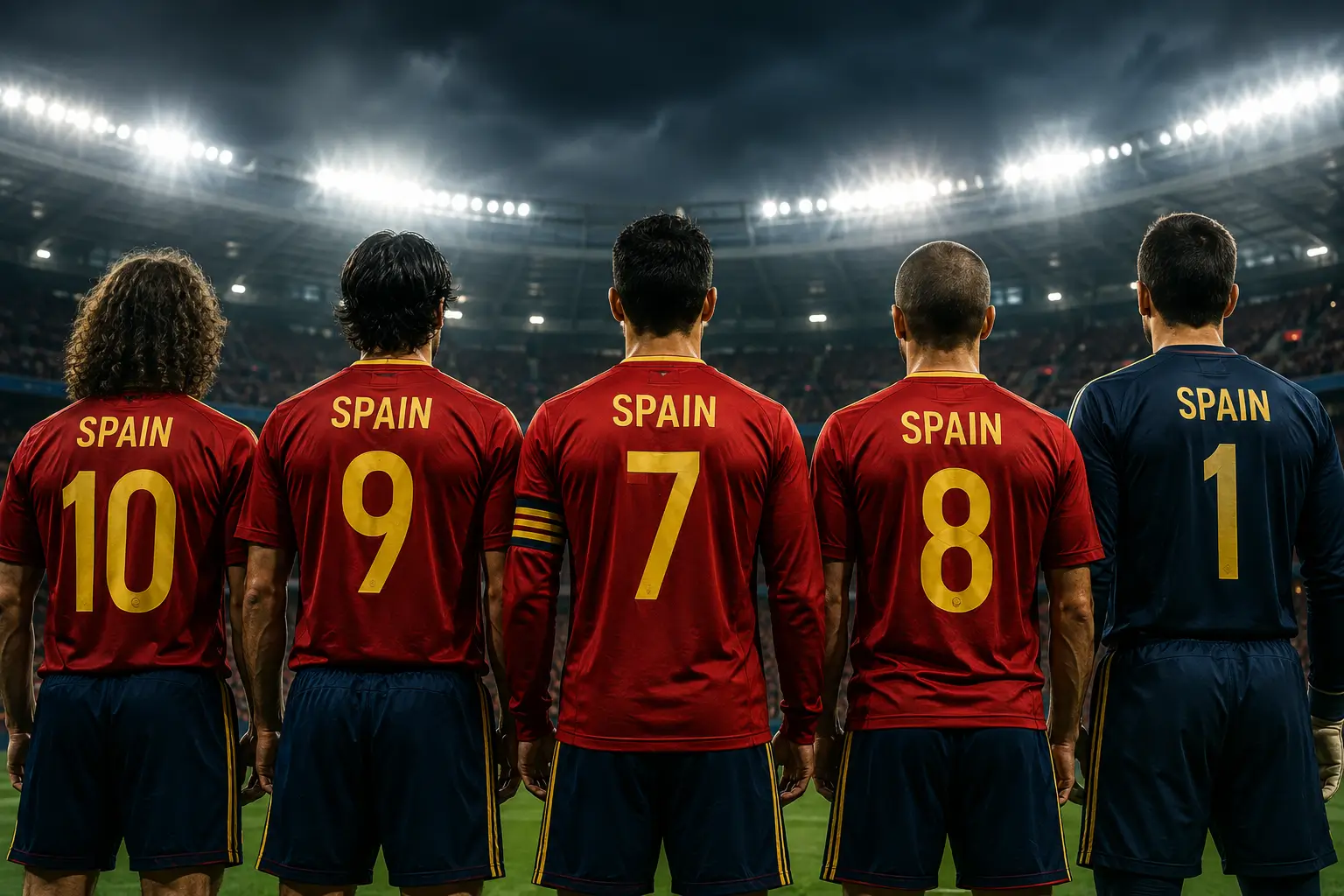
Andrés Iniesta ranks first in FootballerRank’s best Spanish football players of all time list, narrowly ahead of Xavi Hernández. Iniesta combines a long Barcelona career with the winning goal in the 2010 World Cup final and the Euro 2012 Player of the Tournament award. Iker Casillas completes our top three for his goalkeeping and captaincy during Spain’s three-title run from 2008 to 2012.
This list compares senior men’s careers through individual peak, sustained contribution, Spain performances and club work. Rodri’s achievements through the completed 2026 World Cup are included. The records support each player’s case, while the order remains our editorial judgment. It is not an official federation ranking, and one trophy or individual award does not decide every place.
Key Takeaways
- Iniesta and Xavi lead, with the narrow difference explained through their roles and major-match contribution.
- Casillas is our highest-ranked goalkeeper; Ramos is our highest-ranked defender.
- Rodri’s 2024 Ballon d’Or and 2026 World Cup Golden Ball strengthen his case for fifth.
- Villa’s 59 goals in 98 Spain appearances give him the strongest national-team scoring record among these ten players.
- Winning a European campaign and playing in its final are separate achievements.
The Top 10 Spanish Football Players
| Rank | Player | Main role | Key evidence |
| 1 | Andrés Iniesta | Central midfielder | 2010 World Cup final winner; Euro 2012 best player |
| 2 | Xavi Hernández | Central midfielder | Euro 2008 best player; sustained midfield control |
| 3 | Iker Casillas | Goalkeeper | Captain for three major Spain titles; 2010 Golden Glove |
| 4 | Sergio Ramos | Centre back and right back | 180 Spain caps; four Madrid Champions League wins |
| 5 | Rodri | Defensive midfielder | 2024 Ballon d’Or; 2026 World Cup Golden Ball |
| 6 | Luis Suárez Miramontes | Midfielder | 1960 Ballon d’Or; Euro 1964; two European Cups |
| 7 | Raúl González | Forward | Long Madrid scoring career; three European titles |
| 8 | David Villa | Striker | 59 Spain goals; Euro 2008 top scorer |
| 9 | Carles Puyol | Centre back | 2010 World Cup semifinal winner; defensive leadership |
| 10 | Sergio Busquets | Defensive midfielder | 143 Spain caps; World Cup and Euro winner |
Eligibility and Ranking Method
This edition focuses on Spain-born players who represented the senior men’s national team. That rule keeps the original selection consistent. Alfredo Di Stéfano represented Spain but was born in Argentina, so he remains outside this edition. A ranking of all players who represented Spain could include him and would need a different selection.
We give greatest weight to individual peak and sustained influence, with Spain performances carrying substantial weight in this country ranking. Club football supplies a larger sample of regular work. A player’s role, competition and responsibility matter alongside the titles his team won.
| Factor | What it tells us |
| Individual peak | How strongly the player performed in his own position |
| Sustained contribution | Whether that level lasted across several campaigns |
| Spain career | Tournament influence, major matches and national-team responsibility |
| Club career | Regular performance and contribution in leading competitions |
| Era and role | The conditions, tactical duties and opportunities of the player’s period |
| Awards | Supporting evidence of an outstanding campaign or tournament |
Different positions need different evidence. A striker’s scoring record can be decisive, while a defensive midfielder’s positioning and passing may be more useful. We assess Casillas through saves, consistency and command rather than expecting his record to resemble an attacker’s.
An active player can qualify. Rodri’s fifth place reflects the balance of his proven peak and career length, not a rule requiring retirement. Future achievements receive no credit. Earlier players also had fewer international fixtures and different club formats, so raw appearance totals cannot settle comparisons across eras.
1. Andrés Iniesta
Central and attacking midfielder | 131 Spain appearances | World Cup winner in 2010
Iniesta’s winning goal in the 116th minute of the 2010 final gave Spain a 1-0 victory over the Netherlands. It is the clearest major-match moment in his case. His place at No. 1 also rests on years of high-level midfield play, so the ranking does not depend on that goal alone.
He helped Spain win the European Championship in 2008 and 2012. UEFA named him the best player of the 2012 tournament, adding individual evidence to the team result. His close control and ability to carry the ball out of crowded midfield areas helped Spain turn possession into attacking progress.
Barcelona’s historical profile records nine league titles and four Champions League titles, with 674 official appearances. That long club sample supports the international case. We give him a narrow edge over Xavi because of his combined ball carrying and direct contribution in Spain’s biggest matches. Xavi has a close alternative case through his control of whole games.
2. Xavi Hernández
Central midfielder | 133 Spain appearances | Euro 2008 Player of the Tournament
Xavi controlled the pace and direction of Spain’s possession game. His awareness before receiving the ball allowed him to keep passing moves alive and find the next free teammate. UEFA’s Euro 2008 award recognizes the quality of that contribution during Spain’s first major title since 1964.
He also played a central role in the 2010 World Cup and Euro 2012 successes. His importance came from repeated involvement in midfield, rather than one isolated winning action. We rank him above Casillas because his passing helped define the team’s approach throughout that period.
Barcelona records eight La Liga titles, four Champions League winning campaigns and 767 appearances. The 2006 European title needs one qualification: Xavi stayed on the bench in the final, as UEFA’s retrospective confirms. Four winning campaigns therefore do not mean four finals played. We place him just behind Iniesta, with midfield control a strong reason to prefer Xavi if that quality receives greater weight.
3. Iker Casillas
Goalkeeper | 167 Spain appearances | Captain of the 2008 to 2012 title run
Casillas captained Spain to Euro 2008, the 2010 World Cup and Euro 2012. His 2010 tournament provides strong individual evidence. FIFA records five clean sheets in seven matches and only two goals conceded. The four knockout matches all ended with Spain keeping a clean sheet.
His saves against Arjen Robben in the final helped keep Spain level before Iniesta scored. FIFA awarded him the Golden Glove. Those actions should remain separate from captaincy and team success: he was also performing the goalkeeper’s job at an exceptional tournament level.
Real Madrid confirms five league titles and three Champions League titles during his club career. His sustained first-team record adds weight beyond Spain’s golden generation. He ranks above Ramos because of his decisive goalkeeping and repeated international leadership in our assessment. Comparing the two requires positional judgment, rather than adding their trophies and declaring a winner.
4. Sergio Ramos
Centre back and right back | 180 Spain appearances | Three major Spain titles
The Spanish federation records Ramos at 180 senior appearances. He played at right back during Spain’s 2008 and 2010 victories, then at centre back during Euro 2012. His success across those defensive roles adds to his case, though each role required different positioning and responsibilities.
His Real Madrid career included five La Liga titles and four Champions League titles. His late headed equaliser against Atlético Madrid in the 2014 European final is a notable example of major-match attacking contribution from a defender. The rest of his case still depends on defending, regular responsibility and leadership.
We place Ramos above Rodri because his longer body of elite club and international work carries greater weight. Rodri’s recent individual awards make the comparison closer, but they do not replace Ramos’s sustained defensive contribution. Ramos also ranks above Puyol for his wider career sample and repeated European success.
5. Rodri
Defensive and central midfielder | 2024 Ballon d’Or | 2026 World Cup Golden Ball
Rodri’s individual honours create one of the strongest peaks in this selection. UEFA named him Player of the Tournament at Euro 2024 and confirmed his Ballon d’Or win later that year. FIFA then awarded him the Golden Ball at the completed 2026 World Cup, which Spain won.
His club evidence is substantial too. He scored Manchester City’s winning goal against Inter in the 2023 Champions League final. His deeper role involves keeping possession available, protecting the central area and helping the team recover control when attacks break down. That work matters beyond goals.
Rodri ranks above Luis Suárez and Busquets because we give his combined club peak and tournament recognition a narrow advantage. Suárez’s European Cup record and Busquets’s longer Barcelona and Spain service create serious competing cases. Rodri remains below the first four because their sustained elite samples are longer. His active status itself does not affect eligibility. This broad Spain ranking gives individual peak and international tournament awards more weight than our specialist defensive-midfield ranking, where sustained work in the holding role carries more weight.
6. Luis Suárez Miramontes
Midfielder and inside forward | 32 Spain appearances and 13 goals | 1960 Ballon d’Or
This entry concerns the Spanish midfielder Luis Suárez Miramontes, rather than the Uruguayan striker of the same name. He won the 1960 Ballon d’Or while at Barcelona. His passing and creative role later became central to Inter’s successful team of the 1960s.
UEFA’s historical account confirms two European Cups in 1964 and 1965 and three Italian league titles with Inter. He also helped Spain win the 1964 European Championship. These are strong club and national-team achievements from an earlier generation.
His 32 Spain appearances should be read in that historical context. Modern internationals have far more fixtures, so a smaller cap total does not prove lower ability. We place him sixth because Rodri’s combined individual peak receives slightly greater weight, while Suárez’s creative quality and European success put him above the final four. A stronger emphasis on early European dominance could move him higher.
7. Raúl González
Forward and second striker | 102 Spain appearances and 44 goals
Raúl was Spain’s leading international scorer before Villa passed him. His national-team career ended with 44 goals in 102 appearances. He did not win a major tournament with Spain, but that outcome also reflects the team and period in which he played.
His Real Madrid career brought six league titles and three Champions League titles. Madrid’s historical profile confirms that he scored in both the 2000 and 2002 European finals. His movement, anticipation and finishing supplied repeated high-level attacking contribution.
We place him narrowly above Villa because his longer period as a leading club forward carries greater weight in the full-career comparison. Villa has the stronger Spain tournament record and would rank above him in a list focused mainly on national-team attacking impact. Raúl’s place therefore rests on the stated balance between club and international work, rather than dismissing Villa’s scoring record.
8. David Villa
Striker | 59 goals in 98 Spain appearances | Euro 2008 top scorer
The federation confirms Villa’s completed Spain record at 59 goals in 98 matches. He scored four goals at Euro 2008 to lead the tournament’s scoring, then added five during Spain’s 2010 World Cup-winning campaign. Those goals supplied direct attacking value in tournaments where Spain often won by a narrow margin.
Villa could finish with either foot and play centrally or from the left. His club career included Valencia, Barcelona and Atlético Madrid. With Barcelona, he won the 2011 Champions League and scored in the final against Manchester United.
He ranks above Puyol because we give his repeated tournament scoring and Spain attacking responsibility a slight edge. Puyol’s defensive case remains strong. Villa’s eighth place should not obscure that he has the best completed national-team scoring total among the players in this table.
9. Carles Puyol
Centre back | 100 Spain appearances | World Cup and Euro winner
Puyol’s most famous Spain goal decided the 2010 World Cup semifinal against Germany. His header from Xavi’s corner gave Spain a 1-0 win and its first place in a men’s World Cup final. His wider contribution came through marking, reading danger and organizing the defensive line.
He also helped Spain win Euro 2008. Barcelona’s records support six La Liga titles and three Champions League titles, with his leadership central to that club career. His Spain honours here cover 2008 and 2010; he was not part of the Euro 2012-winning squad.
We place Puyol above Busquets because his defensive leadership and direct semifinal contribution receive a narrow edge. Busquets’s longer international sample could support the reverse order. Puyol’s position acknowledges the role of defenders in Spain’s success without trying to compare his scoring rate with Villa’s.
10. Sergio Busquets
Defensive midfielder | 143 Spain appearances | World Cup 2010 and Euro 2012 winner
The federation confirms that Busquets ended his Spain career after 143 appearances. He helped Spain win the 2010 World Cup and Euro 2012, including starting the 2010 final. His role supplied defensive balance and short passing support behind the more advanced midfielders.
Barcelona records nine La Liga titles and three Champions League titles. His positioning before receiving the ball helped him avoid pressure and keep possession moving. Recovering the ball and covering space were also central duties, even when they did not create a highlight.
He takes the final place for sustained control, major international contribution and long club service. Xabi Alonso and David Silva are close alternatives. Rodri ranks higher here because of his individual peak and tournament awards, while Busquets has the stronger longevity case. The tenth position is a close selection choice rather than a large gap in ability.
Completed Spain Records in the Top 10
| Player | Completed Spain appearances |
| Andrés Iniesta | 131 |
| Xavi Hernández | 133 |
| Iker Casillas | 167 |
| Sergio Ramos | 180 |
| Luis Suárez Miramontes | 32 |
| Raúl González | 102 |
| David Villa | 98 |
| Carles Puyol | 100 |
| Sergio Busquets | 143 |
These are completed senior national-team careers, using the federation’s standard appearance records and UEFA’s Suárez profile. Rodri is omitted because his record remains open. Appearance totals describe international involvement rather than relative ability. Some historical lists count additional fixtures, so the source’s method matters.
Spain Tournament Titles and the Two Generations
Spain’s men won the World Cup in 2010 and 2026. FIFA confirms the second title came with a 1-0 extra-time victory over Argentina, decided by Ferran Torres in the 106th minute. Rodri’s Golden Ball is an individual award; the World Cup itself is a team achievement.
Spain also won the European Championship in 1964, 2008, 2012 and 2024. The 2008 to 2012 generation won three consecutive major tournaments. Rodri’s newer generation added Euro 2024 and the 2026 World Cup. Both eras provide strong candidates, but a team’s title cannot by itself establish that every member deserves an all-time Top 10 position.
For this edition, the older generation has the stronger combined career sample. Several of its players had long club careers alongside repeated international success. The newer generation can change that comparison through further proven performances, rather than projected future results.
Strong Candidates Outside the Top 10
Xabi Alonso is one of the closest midfield alternatives. His deep passing and contribution to Spain’s three-title run create a substantial case. David Silva offers another route through creative play and sustained club influence. We give Busquets’s specialist defensive-midfield contribution the final-place edge, while recognizing that either could enter under a different balance of priorities.
Fernando Torres scored the winning goal in the Euro 2008 final and belonged to Spain’s three-title generation. Villa receives greater weight here for his completed international scoring record and tournament output, while Raúl has the stronger sustained club case in our assessment.
Dani Carvajal deserves serious consideration. Real Madrid records six European Cup-winning campaigns through 2024, and he scored in that year’s final. That repeated club success challenges the lower places. Our selection still gives the included players a narrow edge across their combined national-team and individual records.
Fernando Hierro, Emilio Butragueño, Telmo Zarra, Paco Gento and Andoni Zubizarreta add important historical cases. Their absence should not be read as proof that every modern player ranks above every earlier star. A list giving more weight to earlier domestic dominance or European Cup success could change the order.
Lamine Yamal has already earned major senior evidence, including Euro 2024 and Spain’s 2026 World Cup success. We assess that work directly, rather than excluding him simply because he is young. His total senior sample is still smaller than those of our ten choices. Future potential belongs in a separate comparison.
To compare Rodri and Busquets with other specialists, see our best defensive midfielders of all time.
For further national selections, explore our football player rankings by country.
Frequently Asked Questions
Who is the best Spanish football player of all time?
Iniesta ranks first in FootballerRank’s editorial assessment, narrowly ahead of Xavi. His long club peak, World Cup final goal and Euro 2012 award support the choice.
Why is Iniesta above Xavi?
We give Iniesta’s ball carrying and direct major-match contribution a narrow edge. Xavi’s passing and control provide a strong alternative case. Both have the records to support first place.
Which players lead the completed Spain appearance and goal records here?
Ramos has the largest appearance total in this selection with 180 caps. Villa has the largest goal total with 59 in 98 matches. These different records measure different contributions.
Why is Rodri above Busquets?
Rodri’s Ballon d’Or, Euro 2024 best-player award and 2026 World Cup Golden Ball strengthen his individual peak case. Busquets offers greater completed Spain and Barcelona longevity. Our ranking gives Rodri’s peak the edge.
Why is Alfredo Di Stefano outside this list?
This edition focuses on Spain-born senior men’s internationals. Di Stéfano represented Spain but was born in Argentina. A broader list of all Spain internationals could include him and would need a different selection.
Sources and Fact Checking
RFEF supplies the identified Spain appearance and scoring records. UEFA supports the Euro tournament awards, European competition details and Suárez’s historical career. FIFA supports the 2010 goalkeeping evidence, the 2026 final and Rodri’s World Cup award. Barcelona and Real Madrid supply the completed club appearance and honour samples. UEFA’s Ballon d’Or coverage confirms Rodri’s 2024 award.
We separate playing achievements from coaching honours, winning campaigns from finals played, and completed international careers from live records. Spain-born eligibility is stated so Di Stéfano’s exclusion is clear. The checked sources establish the facts; the places and close comparisons remain FootballerRank’s editorial judgments.
Conclusion
In short, Iniesta leads our best Spanish football players of all time ranking, with Xavi and Casillas close behind. Ramos supplies the highest defensive case, while Rodri’s proven peak places him fifth. Suárez, Raúl, Villa, Puyol and Busquets complete a selection based on individual quality, career length and actual club and Spain contribution. The narrow choices depend on how those factors are balanced. Clear eligibility and source notes let readers compare the careers without treating one goal, title or award as the full answer.